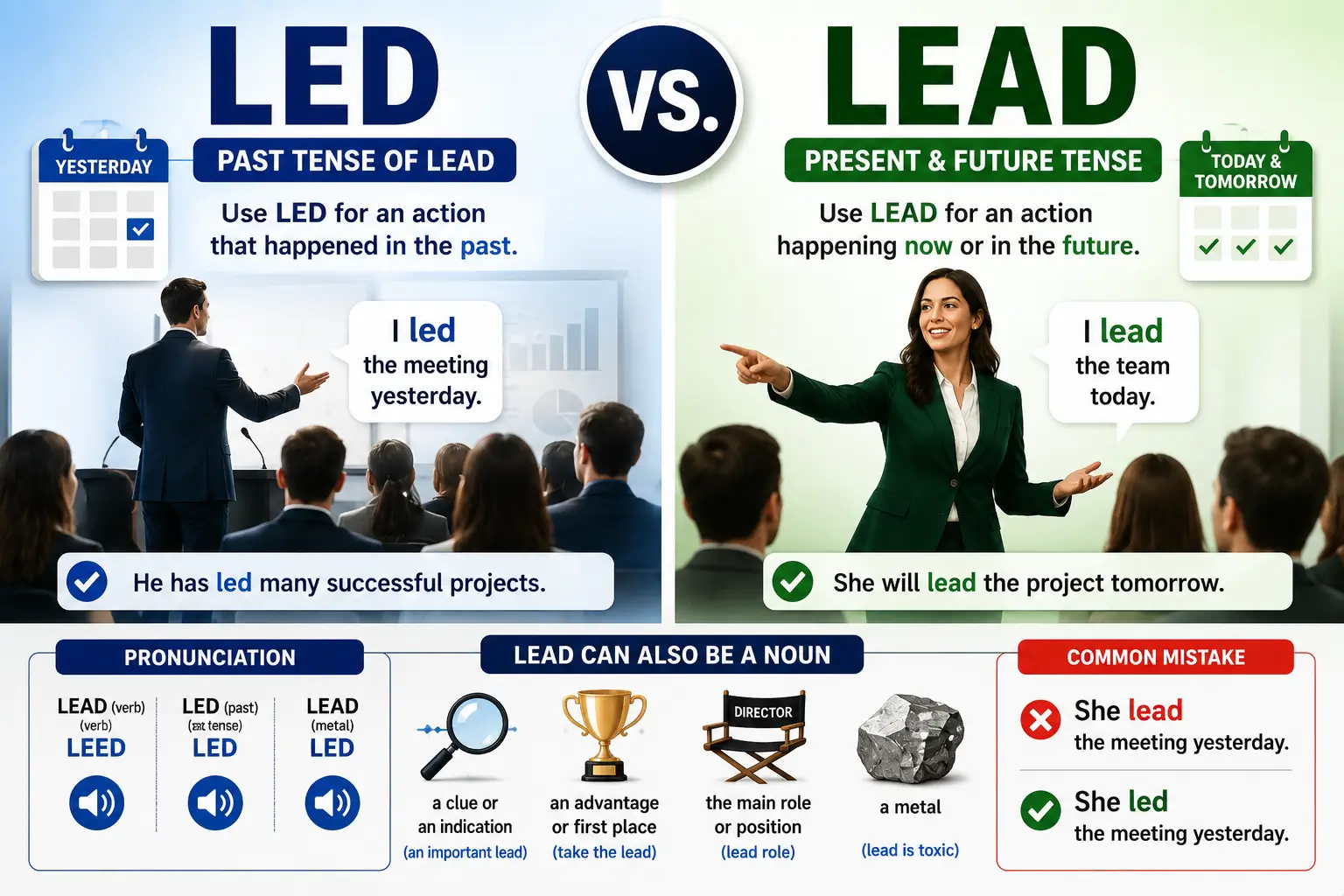
Led vs. lead becomes easy to understand when you focus on time. Use lead for an action happening now or in the future. Use led when the action happened in the past.
For example, “I lead the team” describes a present action, while “I led the team yesterday” describes a completed action. Led is also the past participle, so “has led” and “have led” are correct.
However, lead can also be a noun meaning a clue, an advantage, or the main role. It can also name a heavy metal, where it is pronounced like “led.” This guide explains the meaning, pronunciation, grammar rules, verb forms, and correct usage of both words through simple examples.
Quick Answer: Led vs. Lead
Here’s the simple rule:
Lead = present-tense verb (“to guide”) Led = past tense and past participle of lead Lead can also be a noun. Lead is also the name of a metal, but it’s pronounced differently.
Examples
✅ She leads the marketing team. ✅ She led the marketing team last year. ✅ She has led the marketing team for five years. ✅ The detective found an important lead. ✅ Old pipes may contain lead.
The biggest mistake is writing: ❌ She lead the meeting yesterday.
The correct sentence is: ✅ She led the meeting yesterday.
Why Do People Confuse Led and Lead?
English spelling isn’t always predictable. Lead is one of the best examples.
The word lead has two pronunciations.
| Word | Pronunciation | Meaning |
|---|---|---|
| lead | LEED | to guide |
| lead | LED | the metal |
Because the metal is pronounced exactly like led, many writers assume the past tense is also spelled lead.
It isn’t.
The past tense of the verb lead has always been led.
Led vs. Lead: The Key Difference
The easiest way to remember the difference is to think about time.
| Word | Part of Speech | Meaning |
|---|---|---|
| Lead | Verb | Guide someone now or in the future |
| Led | Verb | Guided someone in the past |
| Lead | Noun | An advantage, clue, or position in front |
| Lead | Noun | A heavy metal |
If the action already happened, use led. If the action is happening now or will happen later, use lead.
What Does Lead Mean?
Lead as a Verb
When lead is a verb, it means to guide, direct, influence, or be in charge.
Examples
She will lead today’s discussion. They lead the company together. Good teachers lead by example. Volunteers lead visitors through the museum.
This meaning appears in everyday conversation, business, education, sports, and leadership.
Lead as a Noun
As a noun, lead has several meanings.
It can mean: an advantage first place guidance an important clue someone who plays the main role
Examples
Our team has a five-point lead. Detectives followed every lead. She got the lead role in the play. His experience gave him the lead during negotiations.
Lead as a Metal
Lead is also the name of a naturally occurring metal.
Although it’s spelled lead, it’s pronounced led.
Examples include: lead batteries lead paint lead pipes lead shielding
Because lead is toxic, many older buildings have removed materials containing it.
What Does Led Mean?
Led is the simple past tense and past participle of lead.
It always describes an action that happened before now.
Examples
She led the parade. They led the discussion. Our manager led the project successfully. The guide led tourists through the cave.
Unlike lead, led has only one meaning and one pronunciation.
Led vs. Lead in Different Tenses
Understanding verb tenses makes choosing the correct word much easier.
| Tense | Correct Form | Example |
|---|---|---|
| Present | lead | I lead the team. |
| Present Continuous | leading | I am leading the team. |
| Past | led | I led the team yesterday. |
| Past Participle | led | I have led the team. |
| Present Perfect | have led | They have led many projects. |
| Future | will lead | She will lead tomorrow’s meeting. |
Notice that lead never becomes the past tense.
Pronunciation Guide
How to Pronounce Lead (Verb)
Pronounced: LEED
Examples: lead a meeting lead a group lead a company
How to Pronounce Lead (Metal)
Pronounced: LED
Examples: lead poisoning lead pipe lead battery
How to Pronounce Led
Always pronounced: LED
Examples: led the class led the discussion led the investigation
Side-by-Side Comparison Table
| Feature | Lead | Led |
|---|---|---|
| Part of speech | Verb, noun | Verb |
| Tense | Present | Past |
| Pronunciation | LEED (verb), LED (metal) | LED |
| Means | Guide, clue, advantage, metal | Guided in the past |
| Example | They lead the project. | They led the project. |
Examples of Lead and Led in Everyday American English
At School
Present: Students lead classroom discussions.
Past: Students led the science fair last year.
At Work
Present: Maria will lead today’s presentation.
Past: Maria led yesterday’s presentation.
In Emails
Present: I’ll lead tomorrow’s client meeting.
Past: Thanks for everyone who led the training session.
In Conversations
Present: You always lead the way.
Past: You led us in the right direction.
In News Headlines
Present: Scientists lead new climate research.
Past: Scientists led a groundbreaking study.
In Sports
Present: The Lakers lead the series.
Past: They led the league in scoring last season.
In Text Messages
Present: Can you lead the group chat?
Past: You led everyone to the restaurant.
Common Mistakes and How to Fix Them
Many grammar errors come from confusing verb tense with spelling.
| Incorrect | Correct | Why |
|---|---|---|
| She lead yesterday. | She led yesterday. | Past tense needs led. |
| We have lead the project. | We have led the project. | Past participle is led. |
| He lead us home. | He led us home. | Action already happened. |
| They will led the meeting. | They will lead the meeting. | After “will,” use the base verb. |
When Lead Is Correct
Use lead when: the action happens now the action happens regularly the action happens in the future it follows a modal verb
Examples: We lead by example. She can lead the team. They will lead tomorrow’s workshop. You should lead with confidence.
How to Know Whether You Need Led or Lead
Ask yourself one question first.
Did the action already happen?
If yes: ✅ led
If no: ✅ lead
Another simple checklist: Happening now → lead Happened yesterday → led After will → lead After can → lead After has/have → led Talking about the metal → lead
Memory Tricks That Actually Work
Yesterday = Led
If yesterday fits naturally into your sentence, choose led.
Example: Yesterday she led the meeting.
Today = Lead
If the action is happening now, use lead.
Example: Today she leads the meeting.
Remember the Verb Pattern
Lead → Led
Just like: feed → fed bleed → bled
Notice the vowel changes in the past tense.
The Metal Is the Exception
Only the metal lead is pronounced like led while keeping the spelling lead.
Common Expressions Using Lead
These phrases appear often in American English.
Lead the Way
Meaning: Show others where to go.
Example: Sarah will lead the way.
Take the Lead
Meaning: Become the person in front or in control.
Example: James took the lead during negotiations.
Lead by Example
Meaning: Show good behavior through your own actions.
Example: Great managers lead by example.
Lead Someone to Believe
Meaning: Cause someone to think something.
Example: His comments led everyone to believe the event was canceled.
In the Lead
Meaning: Currently winning.
Example: Our team is in the lead.
Follow Someone’s Lead
Meaning: Copy another person’s actions.
Example: The interns followed their manager’s lead.
Grammar Rules You Should Know
Lead Is an Irregular Verb
Unlike regular verbs that simply add -ed, lead changes form.
| Base | Past | Past Participle |
|---|---|---|
| lead | led | led |
This pattern must be memorized.
Why “Leaded” Is Rare
Some people assume the past tense should be leaded.
That’s incorrect.
However, leaded appears in a few specialized terms, such as: leaded gasoline leaded glass
In those cases, leaded is an adjective, not a verb.
Difference Between Lead, Led, and Leading
| Word | Grammar Role |
|---|---|
| lead | Base verb |
| led | Past tense |
| leading | Present participle |
Examples: I lead. I led. I am leading.
American vs. British English
One helpful fact is that there is no spelling difference between American and British English.
Both varieties use: lead led
The grammar rule stays exactly the same.
Pronunciation also follows the same pattern.
Synonyms and Related Words
Depending on context, lead can be replaced with:
As a Verb
guide direct manage supervise conduct head oversee escort steer
As a Noun
advantage clue direction front position opening
Choosing a synonym depends on the meaning of the sentence.
Quick Practice Quiz
Choose the correct answer.
She ____ the meeting yesterday. A. lead B. led ✅ Answer: led
They will ____ the discussion tomorrow. A. lead B. led ✅ Answer: lead
He has ____ several successful projects. A. lead B. led ✅ Answer: led
Detectives followed every ____. A. lead B. led ✅ Answer: lead
The company continues to ____ the industry. A. lead B. led ✅ Answer: lead
Real-Life Case Study
Imagine a project manager sending this email:
“Sarah lead the meeting yesterday.”
Although many readers understand the message, the sentence contains a grammar mistake. Because the meeting already happened, led is required.
Correct version: “Sarah led the meeting yesterday.”
Small grammar mistakes like this can reduce credibility in professional writing. Using the correct verb tense helps your emails, reports, and presentations look polished and accurate.
Grammar Tip: If you’re unsure whether to use lead or led, identify the sentence’s tense first. Once you know whether the action is happening now, happened in the past, or will happen in the future, the correct choice usually becomes obvious.
Frequently Asked Questions
1. What is the main difference between led and lead?
Lead is the base form of the verb, while led is its past tense and past participle. We lead today, but we led yesterday.
2. Is led or lead the correct past tense?
Led is the correct past tense of lead. For example, “Sarah led the meeting yesterday” is correct.
3. Is “she lead the team yesterday” correct?
No. Because the action happened in the past, the correct sentence is “She led the team yesterday.”
4. Should I write “has lead” or “has led”?
Always write has led. The same rule applies to have led and had led because led is the past participle.
5. How do you pronounce lead and led?
The verb lead is pronounced “leed.” Led is pronounced as written and rhymes with “red.” The metal lead is also pronounced like led.
6. Can lead function as a noun?
Yes. As a noun, lead can mean an advantage, a clue, the main role, an electrical cord, or a type of metal.
7. Is lead a regular or irregular verb?
Lead is an irregular verb because its past form changes to led instead of simply adding “-ed.” Its forms are lead, led, and led.
8. Is “leaded” the past tense of lead?
No. Leaded isn’t the standard past tense of the verb lead. It appears mainly as an adjective in terms such as leaded gasoline and leaded glass.
9. What is an easy way to remember led vs. lead?
Connect led with “yesterday” and lead with “today.” If the guiding action already happened, use led. If it happens now or later, use lead.
10. Do American and British English use different spellings?
No. Both American English and British English use lead for the base verb and led for the past tense and past participle.
Conclusion
The difference between led and lead mainly depends on grammar, meaning, and pronunciation. Lead is the base form of the verb and usually refers to guiding, directing, or being in front. Led is the past tense and past participle of lead.
Use lead for present or future actions: “They will lead the discussion.” Use led for completed actions: “They led the discussion yesterday.” After has, have, or had, always use led.
Remember that lead may also function as a noun. It can mean a clue, an advantage, a main role, or a toxic metal. Checking the sentence’s time and context will help you choose the correct word confidently.