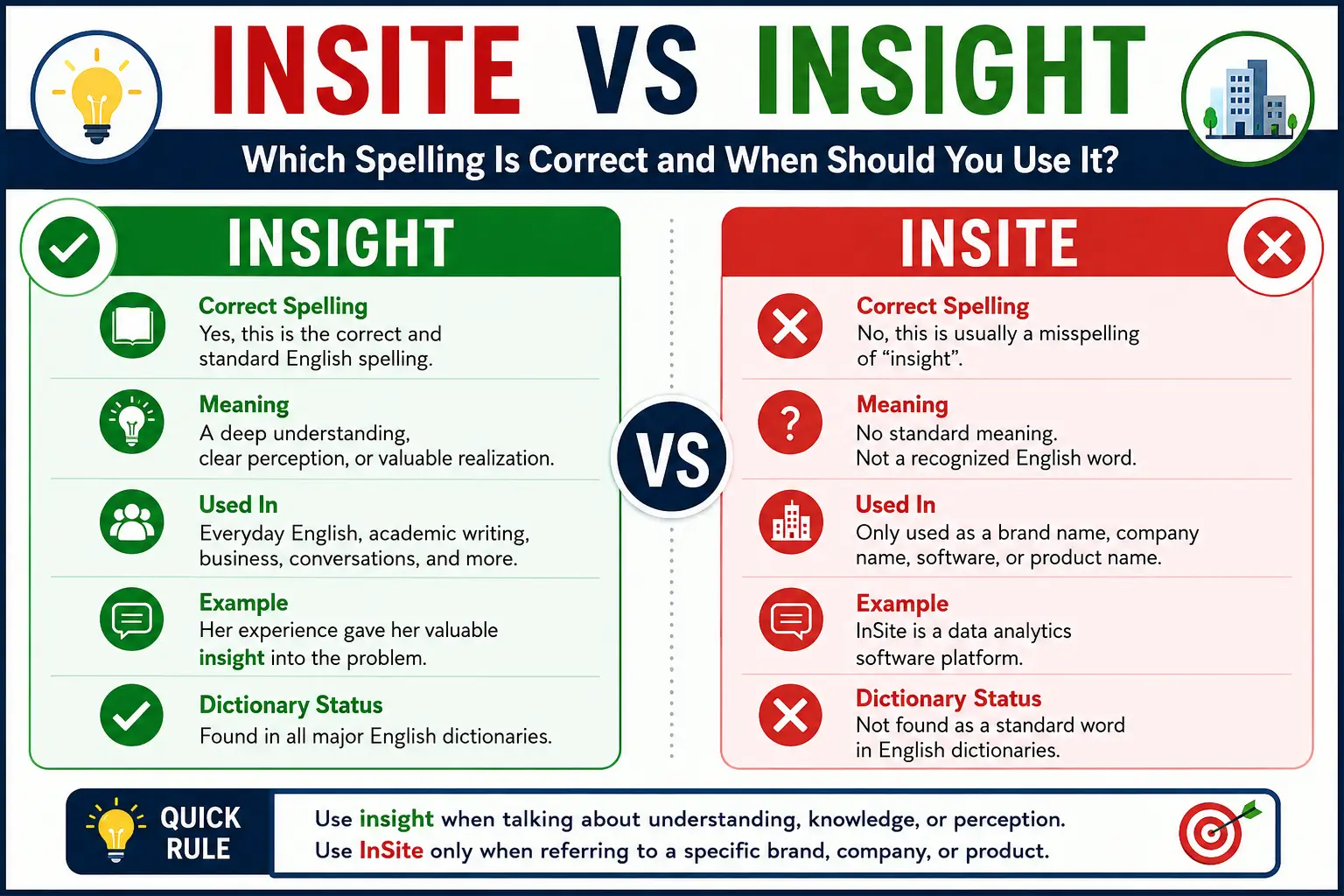
Insite vs Insight: Which One Is Correct?
Have you ever typed insite into Google only to wonder if you spelled it correctly? You’re not alone. Every month, thousands of people search for Insite vs Insight because the two words sound exactly alike. At first glance, they even look similar, making it easy to confuse one with the other.
The good news is that the answer is surprisingly simple.
In standard English, insight is the correct spelling. It refers to a deep understanding, clear perception, or a valuable realization about a person, situation, or problem. Whether you’re writing a school assignment, a business report, a blog post, or a professional email, insight is almost always the word you need.
So where does insite come from?
In most cases, it’s simply a spelling mistake. However, there are a few exceptions. Some companies, software platforms, and organizations intentionally use InSite as part of their brand name. That’s why you may occasionally see it online, leading many people to believe it’s an accepted English word.
Understanding the difference isn’t just about avoiding a spelling error. Choosing the correct word makes your writing look more polished, improves your credibility, and ensures your message is clear. A small mistake can distract readers, especially in academic or professional writing.
In this guide, you’ll learn:
- The correct spelling and why it matters
- The real meaning of insight
- Whether insite is ever correct
- Common mistakes people make
- Easy ways to remember the difference
- Plenty of real-life examples to help you use the word confidently
By the end of this article, you’ll never have to wonder whether to write insite or insight again.
Quick Answer
If you’re looking for the short answer, here it is.
| Word | Correct? | Meaning |
| Insight | ✅ Yes | A deep understanding, awareness, or clear perception. |
| Insite | ❌ Usually No | Generally a misspelling unless it’s part of a company, product, or brand name. |
Read this also: Check-In vs Check In: What’s the Difference and When Should You Use Each?
Remember This Simple Rule
If you’re talking about knowledge, understanding, wisdom, awareness, or clear thinking, always write insight.
Use InSite only when referring to the official name of a business, software application, website, or trademark.
What Does Insight Mean?
The word insight goes beyond simply knowing something. It describes the moment when information starts to make sense and you understand the deeper reason behind it.
Think of it this way:
Knowing that sales dropped last month is information.
Understanding why they dropped is insight.
That’s what makes insight so valuable. It turns facts into understanding and helps people make better decisions.
Definition of Insight
Insight is a noun that means:
- A deep understanding of a subject
- Clear perception of a situation
- The ability to recognize hidden patterns or meanings
- Wise judgment based on experience or careful observation
People gain insight through learning, experience, research, analysis, or thoughtful reflection.
Examples of Insight in Everyday Sentences
Here are a few examples showing how naturally insight is used.
- Her years of teaching gave her valuable insight into children’s learning habits.
- The survey provided useful insight into customer expectations.
- Reading the report gave me a better insight into the company’s strategy.
- His comments offered fresh insight that no one else had considered.
- Good leaders rely on data, but they also trust their insight.
Notice that in every example, insight refers to a deeper understanding—not just basic information.
Is Insite a Real Word?
This is where many people become confused.
Technically, insite is not a standard English dictionary word with the same meaning as insight. If you’re writing an essay, email, article, or report, using insite instead of insight is considered a spelling mistake.
For example:
❌ The article gave me great insite.
✅ The article gave me great insight.
So why do people keep seeing InSite online?
The reason is simple. Some businesses intentionally use InSite as a brand name because it’s short, memorable, and resembles the word insight.
You might come across names such as:
- InSite Analytics
- InSite Software
- InSite Learning
- InSite Solutions
In these cases, InSite is a proper noun, not a regular English vocabulary word.
A good way to remember this is:
- Writing about understanding or knowledge? → Insight ✅
- Writing about a specific company named InSite? → InSite ✅
Outside of brand names, insight is almost always the correct choice.
Why Do So Many People Confuse Insite and Insight?
The confusion isn’t surprising.
Several factors make these words easy to mix up.
1. They Sound Exactly the Same
Insight and insite are pronounced identically. Since English contains many words that sound alike but have different spellings, people often rely on pronunciation when writing—and that’s where mistakes happen.
2. Brand Names Create Confusion
Many software companies and consulting firms use InSite as their official name. After seeing it online, people naturally assume it’s an accepted alternative spelling.
3. Spell Check Doesn’t Always Help
If InSite appears as a proper noun or trademark, some writing tools may not flag it as an error. That can make writers believe both spellings are equally correct.
4. Fast Typing Leads to Mistakes
When writing quickly, it’s easy to type words the way they sound instead of how they’re actually spelled.
Fortunately, once you understand the difference, it’s one of the easiest spelling mistakes to avoid.
Insite vs Insight: Side-by-Side Comparison
If you’re still unsure which spelling to use, this comparison table makes the difference easy to understand at a glance.
| Feature | Insight | Insite |
| Correct English Word? | ✅ Yes | ❌ No (except as a brand or company name) |
| Part of Speech | Noun | Proper noun (only in specific brand names) |
| Meaning | A deep understanding, clear perception, or valuable realization | Usually a misspelling of insight |
| Used in Everyday English? | ✅ Frequently | ❌ No |
| Found in Dictionaries? | ✅ Yes | ❌ Not as a standard English word |
| Common Usage | Academic writing, business, education, psychology, journalism, and everyday conversation | Company names, software, websites, trademarks, and products |
| Example | “Her experience gave her valuable insight.” | “InSite is the name of the company’s analytics platform.” |
| Should You Use It? | ✅ Yes, in almost every writing situation | ❌ Only when referring to an official brand or product |
Key Takeaway
The rule is simple:
- Use insight whenever you’re talking about understanding, knowledge, awareness, perception, or wisdom.
- Use InSite only if it’s the official name of a company, software platform, product, or organization.
A Quick Memory Trick
Think of the word insight as:
In + Sight = Seeing Inside
When you have insight, you can “see inside” a problem or situation and understand what others may overlook.
That’s why insight means deep understanding or clear perception—not just seeing with your eyes, but seeing the meaning behind the facts.
Key Differences Between Insite and Insight
Although insite and insight sound exactly the same, they are not interchangeable. One is a standard English word used in everyday writing, while the other is generally seen only as part of a brand or company name.
Let’s break down the differences in more detail.
1. Meaning
The biggest difference is their meaning.
Insight means a deep understanding or clear perception of something. It often refers to recognizing the true nature of a situation after careful thought, experience, or analysis.
Examples:
- The interview gave me valuable insight into the hiring process.
- Her research offers new insights into climate change.
- Good managers use data to gain insight before making decisions.
By contrast, insite has no accepted meaning in standard English. If you use it in place of insight, it is considered a spelling mistake.
Read this also: Faring vs Fairing: What’s the Difference and Which One Should You Use?
2. Correctness
When writing for school, work, or publication, insight is the correct spelling.
Use insight in:
- Academic essays
- Blog posts
- Business reports
- Emails
- News articles
- Books
- Marketing content
- Professional documents
The spelling insite is only correct when it is part of an official name, such as a company, software application, or trademark.
3. Dictionary Status
Another important difference is dictionary recognition.
You’ll find insight in every major English dictionary because it’s an established word with a clear definition.
On the other hand, insite is not listed as a standard English noun. If it appears in dictionaries at all, it’s usually identified as a variant used in proper names or noted as a common misspelling of insight.
4. Everyday Usage
You’ll encounter insight almost everywhere.
People use it in conversations, books, podcasts, business meetings, research papers, and online articles because it’s a common way to describe understanding or wisdom.
For example:
- Market insights
- Customer insights
- Personal insight
- Financial insights
- Industry insights
- Psychological insight
These are all natural and widely accepted expressions.
By comparison, you rarely see InSite unless you’re referring to a specific business or product.
5. Professional Writing
Using the correct spelling matters.
Writing insite instead of insight can make your work look unprofessional and may cause readers to question your attention to detail.
Whether you’re creating a resume, writing a research paper, publishing a blog, or sending an important email, choosing insight helps your writing appear polished and credible.
How to Use Insight Correctly
Knowing the meaning is only the first step. You also need to know how to use insight naturally in a sentence.
Because insight is a noun, it usually refers to knowledge, understanding, or awareness gained through experience, observation, or analysis.
Use Insight When Talking About Understanding
Examples:
- Her presentation provided valuable insight into the company’s future plans.
- The report offers useful insight into consumer behavior.
- Travel can give people insight into different cultures.
- The documentary gave viewers a new insight into marine life.
- Years of experience gave him the insight needed to solve complex problems.
Common Phrases with Insight
You’ll often see insight used in these expressions:
- Gain insight
- Provide insight
- Offer insight
- Share insight
- Give insight
- Valuable insight
- Useful insight
- Deep insight
- Fresh insight
- Greater insight
These phrases are common in both formal and informal English.
Examples in Different Contexts
Business
- Customer feedback gave us valuable insight into buying habits.
Education
- The professor shared fascinating insights about ancient history.
Healthcare
- The study provides new insight into heart disease.
Technology
- Data analytics helps companies gain insight into user behavior.
Personal Growth
- Journaling can help you develop greater insight into your emotions.
No matter the context, insight always refers to a deeper level of understanding rather than simple facts or information.
Insight Into vs Insight On vs Insight About
One of the most common questions after learning the word insight is how to use it correctly with prepositions. You’ll often see insight into, insight on, and insight about, but they are not equally common.
1. Insight Into (Most Correct & Natural)
The most widely used and grammatically preferred form is insight into.
It means a deeper understanding of a subject, situation, or process.
Examples:
- The report gives insight into customer behavior.
- She gained insight into human psychology.
- The interview provided insight into the hiring process.
This is the form you should use in most cases.
2. Insight On (Less Common)
Insight on is sometimes used, but it is less natural in formal writing.
It is often seen in casual speech or headlines.
Examples:
- The expert shared insight on climate change.
- He gave insight on investment strategies.
While acceptable in some contexts, into is usually preferred.
3. Insight About (Occasional Use)
Insight about is the least common of the three.
It is sometimes used in informal writing but is not preferred in professional English.
Example:
- She shared insight about her experience abroad.
In most formal contexts, it is better to replace it with insight into.
Insight vs Incite (Important Confusion)
Many writers confuse insight with incite, but they are completely different in meaning and usage.
| Word | Meaning | Part of Speech |
| Insight | Deep understanding or perception | Noun |
| Incite | To encourage or provoke action, often negative | Verb |
Examples
Insight:
- The study provided valuable insight into human behavior.
Incite:
- The speaker was accused of trying to incite violence.
A simple trick:
- Insight = understanding
- Incite = inspire action (often aggressively)
Plural Form of Insight: Insights
The plural form is insights.
It is very common in business, education, marketing, and research.
Examples:
- The analysis produced several useful insights.
- Customer insights help improve product design.
- Researchers shared new insights from the study.
Using the plural form is natural when referring to multiple findings or understandings.
20+ Real-Life Examples of Insight
Here are practical examples to help you fully understand how insight is used in real communication.
- The data gave us insight into user behavior.
- Her experience provided deep insight into leadership.
- The book offers insight into human emotions.
- The report delivered valuable insight into market trends.
- Teachers develop insight into student learning styles.
- The survey revealed new insights into customer needs.
- Travel gives people insight into other cultures.
- The discussion offered insight into global issues.
- His analysis showed insight into financial risks.
- The interview gave personal insight into the artist’s life.
- The documentary provided insight into wildlife behavior.
- Research brings insight into disease prevention.
- Her comments added valuable insight to the debate.
- The audit gave clear insight into company performance.
- Customer feedback provided actionable insights.
- The study offers scientific insight into brain function.
- Years of experience gave him unique insight.
- The meeting produced strategic insights for growth.
- Social media analytics provide marketing insight.
- The workshop helped participants gain insight into productivity.
Common Mistakes to Avoid
Even advanced writers make mistakes with this word. Here are the most common ones:
❌ Using “insite” instead of insight
- Wrong: The article gave me great insite.
- Correct: The article gave me great insight.
❌ Confusing sight, site, and cite
- Sight = vision
- Site = location
- Cite = reference
These sound similar but have completely different meanings.
❌ Misusing insight as a verb
- Wrong: The report insights customer behavior.
- Correct: The report provides insight into customer behavior.
❌ Overusing incorrect prepositions
- Wrong: insight about the problem (in formal writing)
- Correct: insight into the problem
Memory Tricks to Remember Insight
Here are simple ways to never confuse the spelling again.
1. Sight Trick
Think of insight = seeing inside something.
- In + sight = inner understanding
2. Meaning Connection
If it means:
- Understanding
- Awareness
- Knowledge
- Perception
👉 Always use insight
3. Quick Check Rule
Before writing, ask:
- Am I talking about understanding?
→ If yes, use insight
Frequently Asked Questions (FAQs)
1. What is the correct spelling: insite or insight?
The correct spelling is insight, which means understanding or clear perception.
2. Is insite ever correct?
Only when used as a brand name, company name, or product title like InSite Software.
3. What does insight mean in simple words?
It means a deep understanding of something that is not immediately obvious.
4. Why do people confuse insite and insight?
Because they sound the same and look very similar when written quickly.
5. What is the plural of insight?
The plural form is insights.
Read this also: Moment vs Momment: Which Spelling Is Correct and How to Use It Properly?
Conclusion
The confusion between insite vs insight is very common, but the rule is simple: only insight is the correct spelling in standard English. It represents understanding, awareness, and clear perception, while insite is usually just a misspelling or a brand name.
By learning the difference, you improve your writing accuracy, strengthen your professional communication, and avoid one of the most common English spelling mistakes.
In short:
- Use insight for knowledge and understanding
- Avoid insite in formal writing
- Remember: insight = seeing inside meaning
Once you master this, your writing instantly becomes clearer, more confident, and more professional.