The Simple Answer and Correct Usage
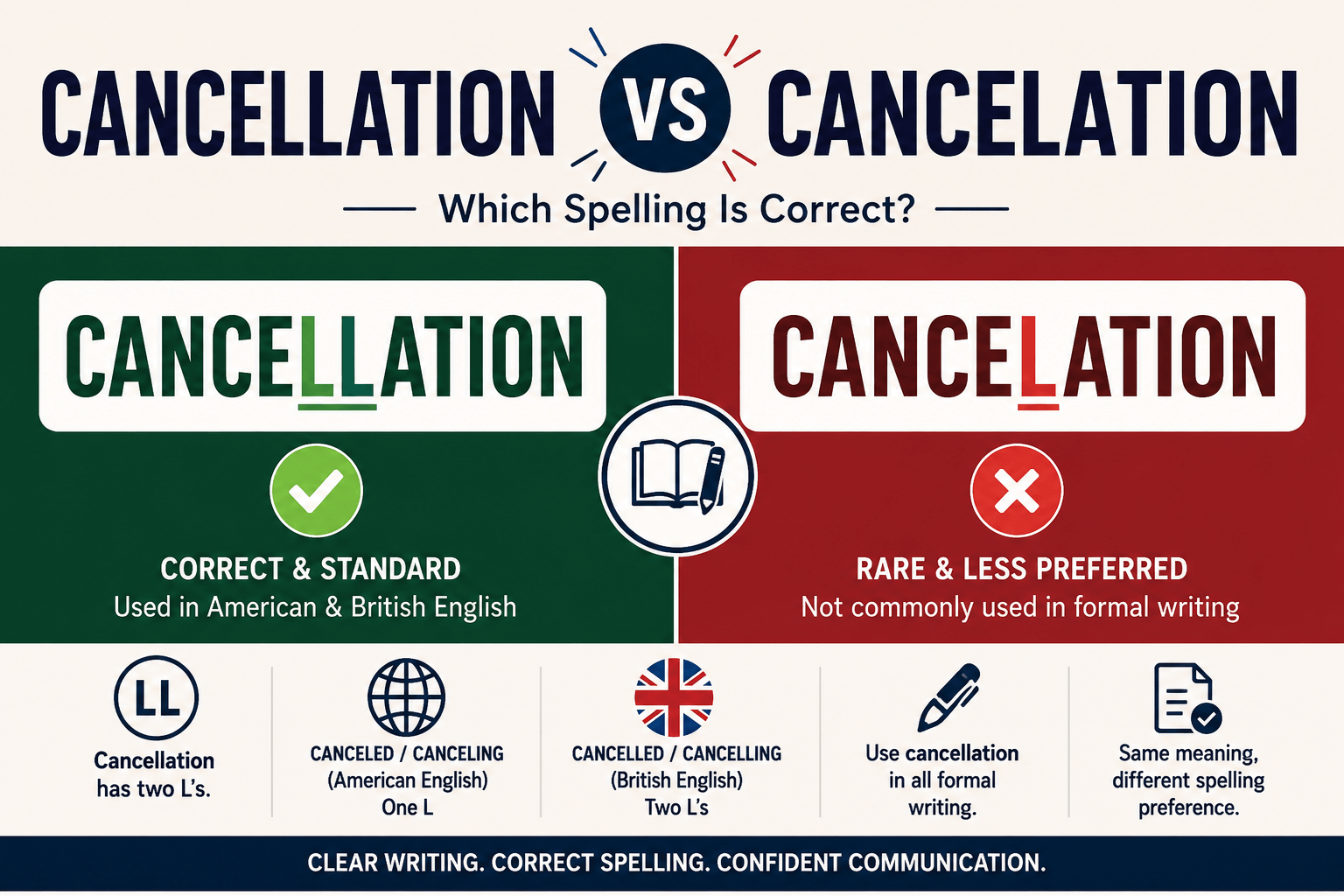
Cancellation vs Cancelation is easier to understand when you know that cancellation is the standard noun in American and British English today.
It means the act of stopping or ending a planned event, appointment, service, or agreement. Cancelation appears as a rare variant, but cancellation is the preferred form in formal documents, academic writing, business emails, school notices, and online content. Use the double-L spelling when you want clear, professional writing.
Regional rules mainly affect the verb forms. American English usually uses canceled and canceling, while British and Australian English often use cancelled and cancelling. The noun stays cancellation in all three varieties. This simple pattern improves spelling accuracy, prevents common writing errors, supports editorial consistency, and gives readers confidence. When checking your work, separate the noun from the verb instead of guessing from regional spelling. It also makes policies easier to understand quickly.
.
Quick Answer: Cancellation or Cancelation?
Use cancellation with two Ls.
It is the standard spelling in nearly every form of modern English. You can safely use it in:
- Business emails
- Academic papers
- News articles
- Contracts
- Cancellation policies
- Travel notices
- Medical communications
- Website copy
- Customer service messages
- Everyday writing
Cancelation, with one L, appears in some American dictionaries as an accepted variant. However, it remains uncommon. Many readers will assume it is a spelling error.
The safest rule: Write cancellation with two Ls, regardless of whether you use American or British English.
Cancellation and Cancelation at a Glance
| Feature | Cancellation | Cancelation |
| Meaning | The act or result of canceling something | The same meaning |
| Number of Ls | Two | One |
| Dictionary status | Standard spelling | Rare variant in some dictionaries |
| American English | Preferred | Occasionally accepted |
| British English | Standard | Generally avoided |
| Professional writing | Recommended | Usually not recommended |
| Pronunciation | kan-suh-LAY-shun | kan-suh-LAY-shun |
| Reader familiarity | Very high | Low |
The two spellings don’t carry different meanings. Their pronunciation also remains identical. The difference lies in frequency, convention, and reader expectation.
See this also: Laser vs Lazer: Which Spelling Is Correct? Meaning, Differences, and Proper Usage
What Does Cancellation Mean?
Cancellation is a noun. It describes the act, process, or result of canceling something.
People often use the word when an event, agreement, booking, service, or plan will no longer continue as expected.
For example:
- “Heavy rain caused the cancellation of the match.”
- “The hotel charges a late cancellation fee.”
- “You’ll receive an email confirming your subscription cancellation.”
- “The doctor had a cancellation this afternoon.”
In the final example, the word has a slightly different sense. A cancellation can refer to an appointment slot that becomes available because another person canceled.
Common Meanings of Cancellation
The word appears in several everyday situations.
Ending a Planned Event
A cancellation can mean that an organized event will not take place.
Examples include:
- A concert cancellation
- A wedding cancellation
- A class cancellation
- A sports event cancellation
- A meeting cancellation
“The venue announced the concert’s cancellation two hours before the doors opened.”
Canceling a Reservation or Appointment
Hotels, restaurants, airlines, clinics, and salons regularly use the word in their policies.
For example:
“Please provide at least 24 hours’ notice for an appointment cancellation.”
Here, the word describes the act of withdrawing a booking.
Ending a Contract or Service
Businesses use cancellation when customers end subscriptions, memberships, insurance policies, or service agreements.
Common phrases include:
- Policy cancellation
- Contract cancellation
- Membership cancellation
- Order cancellation
- Subscription cancellation
For example:
“The company processed the customer’s membership cancellation within three business days.”
An Opening Created by a Canceled Appointment
Doctors, dentists, consultants, and service providers may describe an unexpected opening as a cancellation.
For example:
“We had a cancellation at 10:30, so we can see you earlier.”
In this context, the word refers to the newly available time slot.
Neutralizing a Sound, Signal, or Effect
Technology companies use cancellation when one signal reduces or removes another.
The best-known example is noise cancellation.
Noise-canceling headphones detect external sounds and produce opposing sound waves. These waves reduce the amount of unwanted noise that reaches the listener.
Other technical phrases include:
- Echo cancellation
- Signal cancellation
- Interference cancellation
- Phase cancellation
What Is the Difference Between Cancellation and Cancelation?
The difference involves spelling and usage, not meaning.
Both forms describe the same action. However, cancellation has become the established spelling, while cancelation remains a rare alternative.
Consider these sentences:
- “The airline confirmed the flight cancellation.”
- “The airline confirmed the flight cancelation.”
Both sentences communicate the same idea. Yet the first looks natural to most readers. The second may look unfinished or misspelled.
That reaction matters, especially in professional communication.
Standard Spelling vs. Accepted Variant
A standard spelling is the form that dictionaries, publishers, schools, editors, and readers generally prefer.
A variant spelling is an alternative that has appeared often enough for some dictionaries to record it. However, dictionary recognition doesn’t always mean equal popularity.
English contains many recognized variants. Some remain common, while others fade from normal use.
Therefore, the question isn’t simply, “Can this spelling exist?”
A better question is:
“Which spelling will look correct and familiar to the widest audience?”
For this word, the answer is cancellation.
Does the Spelling Change the Meaning?
No. Adding or removing the second L doesn’t change:
- The definition
- The pronunciation
- The grammatical role
- The tone
- The part of speech
Both forms function as nouns.
However, spelling affects how readers judge the writing. A familiar form feels polished. A rare variant can interrupt the reading experience.
Is Cancelation a Real Word?
Yes, cancelation is a recorded spelling variant.
Some American dictionaries include it because writers have used it in published English. Therefore, calling it completely imaginary would be inaccurate.
However, its existence doesn’t make it the best choice.
Most edited writing uses cancellation. The double-L version also appears across regional varieties of English, making it the more versatile option.
Why Do Dictionaries Include Rare Spellings?
Dictionaries describe real language use. They don’t simply list the forms that teachers or editors prefer.
When a spelling appears repeatedly over time, lexicographers may record it as a variant. The entry tells readers that the form exists and has documented use.
It doesn’t necessarily recommend that form for every situation.
For example, a dictionary may label a word as:
- Rare
- Informal
- Archaic
- Dialectal
- Nonstandard
- A variant spelling
These labels give context. They help readers distinguish between a possible form and the expected form.
When Can You Use Cancelation?
Using the one-L spelling may make sense in a few limited situations.
You might preserve it when:
- Quoting a source exactly
- Copying the official wording of a document
- Referring to a brand, product, or software field that uses it
- Following a company’s established house style
- Discussing the spelling itself
For example:
The original policy used the phrase “service cancelation.”
Quotation marks show that you are reproducing the source rather than choosing the spelling yourself.
When Should You Avoid Cancelation?
Avoid the rare form in writing where clarity, trust, and consistency matter.
That includes:
- School assignments
- University papers
- Legal documents
- Business proposals
- News stories
- Job applications
- Customer support pages
- Healthcare notices
- Government documents
- International publications
A reader may understand the word, but the unfamiliar spelling adds friction. Good writing removes unnecessary obstacles.
Why Is Cancellation Spelled With Two Ls?
English spelling rules explain part of the pattern, but history and convention explain the rest.
The base verb is cancel. When writers add certain endings, the spelling sometimes changes:
- Cancel + ed = canceled or cancelled
- Cancel + ing = canceling or cancelling
- Cancel + ation = cancellation
At first glance, the noun seems inconsistent. American English removes one L in canceled and canceling, yet it keeps two Ls in cancellation.
That inconsistency has become standard.
The Basic Double-Consonant Rule
English often doubles a final consonant before adding an ending that begins with a vowel.
For example:
- Admit becomes admitted
- Begin becomes beginning
- Refer becomes referred
- Occur becomes occurred
The doubling often happens when the final syllable carries the main stress.
Compare these examples:
| Base Word | Stress Pattern | Form With Ending |
| admit | Final syllable stressed | admitted |
| begin | Final syllable stressed | beginning |
| refer | Final syllable stressed | referred |
| visit | First syllable stressed | visited |
| open | First syllable stressed | opened |
| edit | First syllable stressed | edited |
The word cancel places the stress on the first syllable: CAN-cel.
Under the common American pattern, writers usually don’t double the final L before -ed or -ing. That produces canceled and canceling.
British spelling conventions often double a final L even when the last syllable isn’t stressed. As a result, British English favors cancelled and cancelling.
Why the Noun Keeps Two Ls
The noun cancellation follows an established historical spelling rather than a perfectly predictable modern rule.
Writers have used the double-L noun for centuries. Over time, that version became deeply fixed in dictionaries, publishing standards, legal language, and everyday communication.
In other words, English didn’t create the noun by taking the modern American spelling canceled and replacing -ed with -ation.
The word developed as its own established form.
That is why this word family looks mixed in American English:
- Cancel
- Canceled
- Canceling
- Cancellation
English word families often contain similar irregularities. Related words don’t always preserve identical spelling patterns.
A Helpful Memory Trick
Use this sentence:
Canceled may lose an L, but cancellation keeps them all.
You can also break the word into visible parts:
cancel + lation = cancellation
Although this isn’t a technical account of the word’s formation, it works as a memory device.
Another trick is to connect the two Ls to a familiar phrase:
A cancellation can cause double loss: lost plans and lost time.
“Double loss” can remind you to use a double L.
Is It Cancellation or Cancelation in American English?
American English prefers cancellation.
This point causes the most confusion because American writers usually choose:
- Canceled
- Canceling
British writers usually choose:
- Cancelled
- Cancelling
However, both regions normally use:
- Cancellation
Therefore, cancelation isn’t simply the American version of cancellation.
Some American dictionaries list the one-L spelling. Even so, most American publishers, businesses, schools, and news organizations use the double-L noun.
American and British Forms Compared
| Word Form | American English | British English |
| Base verb | cancel | cancel |
| Third-person verb | cancels | cancels |
| Past tense | canceled | cancelled |
| Past participle | canceled | cancelled |
| Present participle | canceling | cancelling |
| Noun | cancellation | cancellation |
This table reveals the real regional difference.
The variation affects the -ed and -ing forms. It usually doesn’t affect the noun.
Canadian English
Canadian English often combines British and American spelling habits. However, Canadian writers generally use:
- Cancelled
- Cancelling
- Cancellation
Individual publications may follow different house styles. Still, cancellation remains the safe noun form.
Australian English
Australian English usually follows the British pattern:
- Cancelled
- Cancelling
- Cancellation
The one-L noun remains uncommon.
International English
When writing for readers in several countries, choose cancellation.
It creates no meaningful regional conflict. Readers in the United States, United Kingdom, Canada, Australia, and other English-speaking regions recognize it immediately.
Canceled vs. Cancelled
Both canceled and cancelled are correct.
The choice depends mainly on the variety of English you follow.
Canceled in American English
American publications usually prefer canceled with one L.
Examples:
- “The airline canceled the flight.”
- “She canceled her appointment.”
- “The school canceled afternoon classes.”
Cancelled in British English
British publications usually prefer cancelled with two Ls.
Examples:
- “The airline cancelled the flight.”
- “She cancelled her appointment.”
- “The school cancelled afternoon classes.”
Neither spelling changes the meaning.
However, consistency matters. A document that jumps between canceled and cancelled may look poorly edited.
Canceling vs. Cancelling
The same regional pattern applies to the -ing form.
American English usually uses canceling:
“The customer is canceling the subscription.”
British English usually uses cancelling:
“The customer is cancelling the subscription.”
Again, both forms are correct.
The noun stays the same:
“The customer asked about the cancellation process.”
Choosing a Regional Style
Before writing a long document, decide which English variety you will follow.
Then apply it consistently.
| Style | Preferred Forms |
| American English | canceled, canceling, cancellation |
| British English | cancelled, cancelling, cancellation |
| Canadian English | often cancelled, cancelling, cancellation |
| Australian English | usually cancelled, cancelling, cancellation |
Document settings can help. Set your word processor to the correct language before running a spelling check.
How to Use Cancellation in a Sentence
The noun works in formal and informal contexts.
Here are practical examples from common industries.
Travel and Transportation
- “Fog caused the cancellation of several morning flights.”
- “Passengers received meal vouchers after the cancellation.”
- “The airline’s cancellation policy explains refund eligibility.”
- “A train cancellation delayed hundreds of commuters.”
- “Travel insurance may cover costs related to a sudden cancellation.”
Hotels and Restaurants
- “The hotel requires 48 hours’ notice for a free cancellation.”
- “Late cancellations may result in a one-night charge.”
- “The restaurant filled the empty table after receiving a cancellation.”
- “Guests can review the cancellation terms before booking.”
Healthcare
- “The clinic has a strict cancellation policy.”
- “A patient cancellation created an opening at noon.”
- “Please call the office if you need to request a cancellation.”
- “Repeated cancellations may delay treatment.”
Events and Entertainment
- “The promoter announced the festival’s cancellation on Monday.”
- “Ticket holders received refunds after the show’s cancellation.”
- “Bad weather led to the cancellation of the outdoor ceremony.”
- “The team confirmed the game cancellation before fans arrived.”
Business and Subscriptions
- “The company sent a cancellation confirmation by email.”
- “Customers must submit a written cancellation request.”
- “The contract includes a 30-day cancellation clause.”
- “Subscription cancellation takes effect at the end of the billing cycle.”
Technology
- “Active noise cancellation reduces low-frequency background sound.”
- “The software uses echo cancellation during video calls.”
- “Poor microphone placement can weaken echo cancellation.”
- “Signal cancellation may occur when opposing waves interact.”
Useful Word Combinations With Cancellation
Certain words regularly appear beside cancellation. Writers call these natural combinations collocations.
Using common collocations makes your writing sound clearer and more fluent.
| Phrase | Typical Meaning |
| Cancellation fee | Money charged when someone cancels |
| Cancellation policy | Rules governing cancellations |
| Cancellation notice | A message announcing a cancellation |
| Cancellation request | A formal request to cancel |
| Cancellation deadline | The last time to cancel without a penalty |
| Cancellation clause | A contract term covering cancellation |
| Cancellation charge | Another term for a cancellation fee |
| Cancellation period | A set time in which cancellation is allowed |
| Cancellation confirmation | Proof that a cancellation was completed |
| Flight cancellation | A flight that will no longer operate |
| Appointment cancellation | A canceled scheduled visit |
| Subscription cancellation | Ending a recurring service |
| Noise cancellation | Technology that reduces unwanted sound |
Cancellation Fee vs. Cancellation Charge
These phrases usually mean the same thing.
A cancellation fee is often clearer and more familiar. Businesses use it for hotels, appointments, tickets, and reservations.
For example:
“Cancellations made within 24 hours will incur a $25 cancellation fee.”
Cancellation Policy
A cancellation policy explains what happens when someone cancels.
A useful policy may cover:
- Notice requirements
- Refund eligibility
- Processing times
- Administrative fees
- Nonrefundable deposits
- Rescheduling options
- Emergency exceptions
Clear wording prevents disputes. It also helps customers understand the consequences before they commit.
Real-Life Scenarios
Spelling choices may seem minor, but they can affect trust, clarity, and brand consistency.
Case Study: A Hotel Booking Page
A hotel publishes this button:
“View Cancelation Policy”
The meaning is clear. However, some customers may pause because the spelling looks unusual.
A more familiar button would read:
“View Cancellation Policy”
The revised wording doesn’t change the rule. It simply removes a distraction at a critical point in the booking process.
Case Study: An International Company
A company has offices in London and Chicago.
The London team writes cancelled, while the Chicago team writes canceled. Both spellings are correct within their regional styles.
However, both offices use cancellation for the noun.
Their style guide might state:
| Region | Past-Tense Verb | Noun |
| United States | canceled | cancellation |
| United Kingdom | cancelled | cancellation |
This approach respects regional conventions without creating confusion.
Case Study: A Medical Clinic
A clinic uses three different phrases across its website:
- Cancelation policy
- Cancellation charges
- Appointment cancelling rules
The inconsistent wording makes the website look less polished.
A clearer set would be:
- Cancellation policy
- Cancellation fees
- Appointment cancellation rules
Consistent terminology also helps patients find information more quickly.
Common Mistakes and How to Fix Them
Several predictable errors cause most of the confusion.
Mistake: Assuming Cancelation Is the American Form
American English often shortens cancelled to canceled. Therefore, some writers assume it also shortens cancellation.
That assumption doesn’t match standard usage.
Use:
- American: canceled
- American: canceling
- American: cancellation
Mistake: Building the Noun From Canceled
Some writers mentally remove -ed from canceled and add -ation:
canceled → cancelation
That method seems reasonable, but English word formation doesn’t always work through direct substitution.
Instead, learn the noun as a separate standard form:
cancel → cancellation
Mistake: Mixing Regional Spellings
Consider this sentence:
“The British organizer canceled the event after several speakers had cancelled.”
Both forms are valid, but using them together without a reason looks inconsistent.
Choose one regional style:
American version:
“The organizer canceled the event after several speakers had canceled.”
British version:
“The organiser cancelled the event after several speakers had cancelled.”
Mistake: Confusing Cancellation With Postponement
A cancellation means the event or plan will not continue as scheduled. It often suggests that it won’t happen at all.
A postponement means the event will happen later.
Compare:
- “The storm caused the concert’s cancellation.”
The concert won’t happen. - “The storm caused the concert’s postponement.”
The concert will happen on a later date.
These words aren’t interchangeable.
Mistake: Confusing Cancellation With Rescheduling
Rescheduling means moving an appointment or event to a different time.
A person may cancel one booking and create another. However, the actions remain distinct.
For example:
“The patient requested a cancellation rather than rescheduling the appointment.”
Mistake: Trusting Spell Check Without Context
Some spell-checking programs accept cancelation, especially when set to American English.
Others flag it.
Software checks whether a word appears in its dictionary. It doesn’t always tell you which option readers prefer.
Therefore, use spell-check as a tool, not as the final authority.
Grammar Tips for Using Cancellation
Correct spelling solves only part of the problem. The word also needs to fit the sentence naturally.
Use Cancellation as a Noun
Cancellation names an action, event, or result.
Correct:
“The cancellation surprised everyone.”
Incorrect:
“The company cancellation the order.”
The second sentence needs a verb:
“The company canceled the order.”
Use Cancel as a Verb
Cancel describes the action.
Examples:
- “They may cancel the meeting.”
- “She canceled the reservation.”
- “He is canceling the service.”
Use Cancellation Before Another Noun
English often places one noun before another to describe its purpose or type.
Examples include:
- Cancellation request
- Cancellation notice
- Cancellation form
- Cancellation fee
- Cancellation process
In these phrases, cancellation describes the second noun.
Use “Cancellation of” for a Specific Event
The phrase cancellation of works well when naming the thing that was canceled.
Examples:
- The cancellation of the flight
- The cancellation of the contract
- The cancellation of the ceremony
- The cancellation of the service
This structure often sounds more formal.
Avoid Unnecessary Wordiness
Wordy:
“We are writing to inform you of the fact that the meeting has experienced a cancellation.”
Clear:
“The meeting has been canceled.”
Or:
“We’re writing to confirm the meeting’s cancellation.”
Strong writing chooses the simplest form that preserves the meaning.
Synonyms for Cancellation
No synonym works in every context. The best choice depends on what stopped and why.
| Synonym | Best Used For |
| Termination | Contracts, employment, services |
| Annulment | Marriages, legal decisions, formal agreements |
| Revocation | Licenses, permissions, rights |
| Abandonment | Plans, projects, attempts |
| Withdrawal | Offers, applications, participation |
| Discontinuation | Products, services, programs |
| Repeal | Laws and regulations |
| Rescission | Contracts and formal legal agreements |
| Reversal | Decisions, charges, transactions |
| Shutdown | Operations, facilities, systems |
| Calling off | Informal events and plans |
| Scrapping | Informal plans or projects |
Cancellation vs. Termination
Cancellation often stops something before completion or prevents it from happening.
Termination usually ends something that already exists, such as employment or a contract.
For example:
- Flight cancellation
- Employment termination
Cancellation vs. Annulment
Annulment has a specific legal sense. It treats an agreement or marriage as invalid.
A cancellation simply ends or withdraws something. It doesn’t always erase its legal existence.
Cancellation vs. Revocation
Revocation means officially taking back a right, license, permission, or offer.
For example:
- Revocation of a driver’s license
- Cancellation of a driving test
Cancellation vs. Discontinuation
Discontinuation often describes the permanent ending of a product, service, treatment, or program.
For example:
- Product discontinuation
- Order cancellation
Related Words and Their Correct Spellings
The word belongs to a larger family.
| Word | Part of Speech | Example |
| Cancel | Verb | “Please cancel the order.” |
| Cancels | Verb | “The system cancels duplicate requests.” |
| Canceled | Verb, US spelling | “They canceled the event.” |
| Cancelled | Verb, UK spelling | “They cancelled the event.” |
| Canceling | Verb, US spelling | “She is canceling the booking.” |
| Cancelling | Verb, UK spelling | “She is cancelling the booking.” |
| Cancellation | Noun | “The cancellation was unexpected.” |
| Cancelable | Adjective, common US form | “The reservation is cancelable.” |
| Cancellable | Adjective, common UK form | “The reservation is cancellable.” |
| Canceler | Noun, less common | “The canceler may pay a fee.” |
| Canceller | Noun, British variant | “The canceller must provide notice.” |
Cancelable vs. Cancellable
The adjective follows the familiar regional split.
American English often uses cancelable.
British English often uses cancellable.
Examples:
- “The ticket is fully cancelable.”
- “The ticket is fully cancellable.”
However, many writers avoid both forms because they can look awkward. A clearer alternative is:
“You can cancel the ticket for a full refund.”
Easy Memory Tricks
Spelling rules help, but a quick memory trick often works better.
Remember the Double-L Noun
Think:
A cancellation causes two losses: lost plans and lost time.
Two losses. Two Ls.
Separate the Verb From the Noun
Memorize these American forms as a set:
- Canceled
- Canceling
- Cancellation
Then memorize the British forms:
- Cancelled
- Cancelling
- Cancellation
The noun stays stable.
Look for “Cancellation Policy”
You’ve probably seen the phrase cancellation policy on hotel, airline, ticket, and appointment websites.
Use that familiar phrase as your reference point.
If cancellation policy looks correct, the same spelling applies elsewhere.
Frequently Asked Questions
Q1.Is cancellation or cancelation correct?
Cancellation is the standard and preferred spelling. Cancelation is a rare variant, but most writers and editors avoid it.
Q2.Is cancelation the American spelling?
Not usually. American English commonly uses canceled and canceling, but the standard noun is still cancellation.
Q3.Why does cancellation have two Ls?
The double-L spelling became the established form of the noun. It remains standard even though American English often uses one L in canceled and canceling.
Q4.What does cancellation mean?
Cancellation means the act of stopping, ending, or calling off something planned, such as an event, appointment, booking, order, or service.
Q5.Which spelling should I use in professional writing?
Use cancellation in business emails, academic papers, formal documents, policies, websites, and customer messages. It is the clearest and most widely accepted choice.
Conclusion
The difference between cancellation and cancelation comes down to standard usage. Cancellation, with two Ls, is the spelling most readers, editors, schools, and businesses expect. It works in American English, British English, and Australian English.
The one-L form, cancelation, appears in some dictionaries as a rare variant. However, it can look like a spelling mistake, especially in formal or professional writing. For clear and consistent communication, use cancellation in emails, reports, policies, articles, and academic work.
Remember that regional spelling mainly affects the verb forms. American English usually uses canceled and canceling, while British English prefers cancelled and cancelling. The noun normally remains cancellation in both styles.