Understanding the Difference Between My and Mine
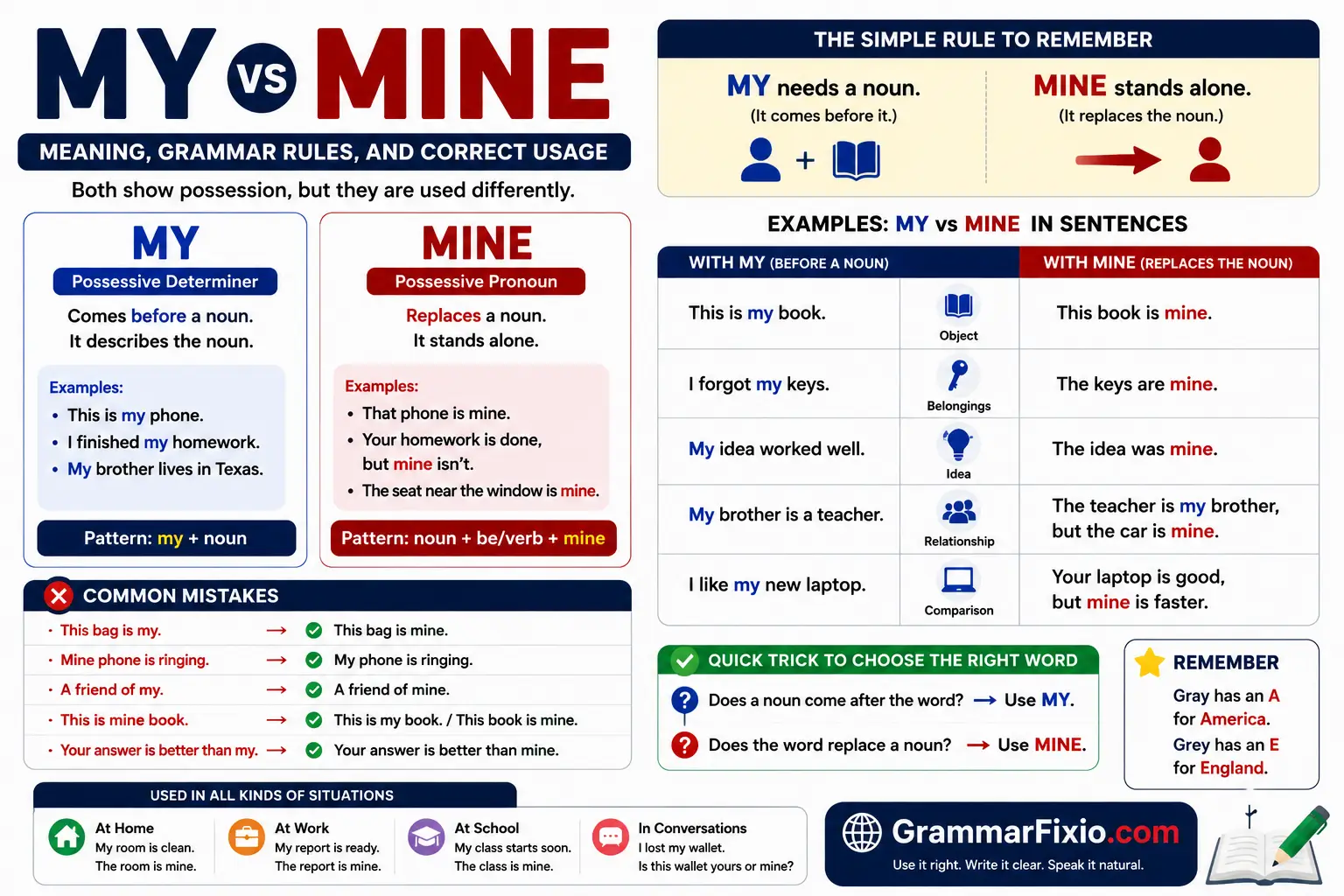
If My vs Mine seems confusing, remember one simple rule: my comes before a noun, while mine replaces the noun in a sentence. Both are possessive words that show ownership, but they are used differently. Learning this rule makes English easier and helps you avoid a common grammar mistake.
In English grammar, my is a possessive adjective, and mine is a possessive pronoun. Many learners confuse these words because they have the same purpose but different usage. Reading simple sentences and practicing them helps you understand the difference, improve your writing, and speak more correctly and naturally in everyday English.
With regular practice, your understanding will grow, and you will use both words with confidence. This small part of grammar improves communication, helps you write better, and makes your speaking sound more natural. Once you learn the rule, choosing My or Mine becomes easy in every sentence.
Quick Answer: What Is the Difference Between My and Mine?
My is a possessive determiner. It comes before a noun and tells you who owns, uses, experiences, or is connected with that noun.
- My phone is charging.
- I finished my assignment.
- My brother lives in Texas.
Mine is a possessive pronoun. It replaces a noun or noun phrase that has already been mentioned or is clear from the context.
- That phone is mine.
- Your assignment is complete, but mine isn’t.
- The seat near the window is mine.
Compare these two sentences:
This is my book.
This book is mine.
Both sentences express the same ownership. However, the grammar is different. My appears directly before the noun book, while mine replaces the phrase my book.
Read this also: Discrete vs Discreet: What’s the Difference and Which Word Should You Use?
My vs Mine at a Glance
| Feature | My | Mine |
| Meaning | Belonging or related to the speaker | Belonging or related to the speaker |
| Grammar role | Possessive determiner | Possessive pronoun |
| Position | Before a noun | Usually stands alone |
| Does a noun follow it? | Yes | No |
| Example | This is my coat. | This coat is mine. |
| Incorrect form | This coat is my. | This is mine coat. |
| Common pattern | my + noun | noun + be + mine |
The main difference is sentence structure. Therefore, you don’t choose between my and mine based on formality or meaning. You choose according to whether a noun follows.
What Does “My” Mean?
My shows that a person, object, idea, relationship, experience, or responsibility belongs to or is connected with the speaker.
For example:
- My keys are on the counter.
- My manager approved the request.
- My opinion has changed.
- My back hurts.
- My responsibility is to review the report.
In each sentence, my introduces a noun. It answers a question such as:
- Whose keys?
- Whose manager?
- Whose opinion?
- Whose responsibility?
The answer is the speaker’s.
“My” Is a Possessive Determiner
Modern grammar usually describes my as a possessive determiner. A determiner is a word placed before a noun to identify or limit it.
In the phrase my laptop, the word my tells you which laptop the speaker means.
Some traditional grammar books call my a possessive adjective because it describes a noun. However, possessive determiner is the more precise term in many modern grammar systems.
You don’t need to memorize the technical label to use the word correctly. Just remember this pattern:
my + noun
Examples include:
- my house
- my teacher
- my children
- my new job
- my final answer
- my personal information
Why “My” Must Come Before a Noun
In standard American English, my normally cannot stand alone. It must introduce a noun or a longer noun phrase.
Correct:
- That is my car.
- I submitted my application.
- My new supervisor starts Monday.
Incorrect:
- That car is my.
- The application is my.
- This desk is my.
These incorrect sentences feel incomplete because my prepares the reader for a noun that never appears.
To correct them, either add the noun or replace my with mine:
- That is my car.
- That car is mine.
What “My” Can Describe
Although my often shows ownership, its meaning is broader than physical possession.
Ownership
- My bicycle is in the garage.
- Someone moved my bag.
Relationships
- My sister works at a hospital.
- I spoke with my neighbor.
You don’t own your sister or neighbor. Instead, my shows a personal relationship.
Body Parts
- My hand is cold.
- I injured my knee.
Ideas and Feelings
- My idea could save time.
- My concern is the deadline.
Experiences
- My trip was exhausting.
- My first day went well.
Work and Responsibility
- My department handles customer support.
- My task is to prepare the slides.
Therefore, possession in grammar can mean ownership, association, experience, or connection.
What Does “Mine” Mean?
Mine means “belonging to me” or “the one connected with me.” Unlike my, it doesn’t need a noun after it.
Examples:
- That umbrella is mine.
- Mine is the black one.
- Your desk is larger than mine.
- She borrowed mine yesterday.
In each example, the missing noun is understood from the context.
For instance:
- Your desk is larger than mine.
Here, mine means my desk. Using the pronoun prevents unnecessary repetition.
“Mine” Is a Possessive Pronoun
A pronoun replaces a noun or noun phrase. Since mine replaces phrases such as my phone, my answer, or my seat, it is called a possessive pronoun.
Consider this repetitive sentence:
- Your laptop is newer than my laptop.
A more natural version is:
- Your laptop is newer than mine.
The word mine replaces my laptop. As a result, the sentence becomes smoother and less repetitive.
Where “Mine” Can Appear in a Sentence
Mine can appear in several positions.
After a Form of “Be”
- The red notebook is mine.
- Those headphones were mine.
- The final decision will be mine.
At the Beginning of a Sentence
- Mine is already finished.
- Mine looks different.
- Mine arrived this morning.
The noun must be clear from the conversation. For example, if two people are discussing packages, mine means my package.
After a Verb
- She borrowed mine.
- Please compare yours with mine.
- He accidentally deleted mine.
In a Comparison
- Your office is larger than mine.
- Her answer was clearer than mine.
- Their schedule is more flexible than mine.
After “Of”
- She is a friend of mine.
- That was an idea of mine.
- He’s a former coworker of mine.
This structure is standard and natural in American English.
The Main Grammar Difference Between My and Mine
The clearest distinction is this:
- My modifies a noun.
- Mine replaces a noun phrase.
The ownership remains the same, but the sentence structure changes.
Compare the following examples:
| Sentence With My | Sentence With Mine |
| This is my seat. | This seat is mine. |
| My answer was correct. | Mine was correct. |
| She borrowed my notes. | She borrowed mine. |
| My desk is near the door. | The desk near the door is mine. |
| I brought my lunch. | I brought mine. |
In the left column, a noun follows my. In the right column, mine replaces the full possessive noun phrase.
“My” Modifies a Noun
The word my cannot replace the noun because its job is to introduce it.
- My jacket is wet.
Here, my modifies jacket.
You can add adjectives between my and the noun:
- My blue jacket is wet.
- My new winter jacket is wet.
Even when adjectives appear, a noun must eventually follow.
“Mine” Replaces a Noun Phrase
The word mine can replace the entire phrase:
- My blue jacket is wet.
- Mine is wet.
The listener must know which object you mean. Therefore, context matters when you use mine.
How to Choose Between My and Mine
You can usually choose the correct form by looking at the next word.
Use “My” When a Noun Comes Next
Choose my when you name the object, person, idea, or experience immediately afterward.
- My phone is missing.
- My professor canceled class.
- My email included the attachment.
- My opinion differs from yours.
- My favorite restaurant is downtown.
The noun may appear directly after my, or an adjective may come between them.
- my car
- my old car
- my reliable old car
The key point is that the phrase eventually includes a noun.
Use “Mine” When the Noun Is Already Known
Choose mine when repeating the noun would be unnecessary.
- Your phone works, but mine doesn’t.
- Her presentation was shorter than mine.
- Is this charger yours or mine?
- That parking space is mine.
In each case, the listener can identify the missing noun.
A Two-Step Decision Test
Ask these questions:
- Does a noun come after the possessive word?
Use my. - Does the possessive word replace the noun?
Use mine.
For example:
- This is ___ notebook.
A noun, notebook, comes after the blank. Therefore, use my:
- This is my notebook.
Now consider:
- This notebook is ___.
No noun follows the blank. The possessive word stands alone. Therefore, use mine:
- This notebook is mine.
A Quick Substitution Test
Try replacing the possessive form with my + noun.
- That seat is mine.
- That seat is my seat.
The second version is grammatically possible, although it sounds repetitive. This shows that mine replaces my seat.
However, you may need to change the sentence structure when switching forms:
- This is my seat.
- This seat is mine.
You cannot simply replace one word with the other without adjusting the sentence.
Correct Sentence Patterns With My and Mine
Learning common patterns makes the distinction easier.
My + Singular Noun
- My account is locked.
- My jacket is in the car.
- My appointment starts at noon.
My + Plural Noun
- My coworkers are helpful.
- My shoes are wet.
- My classes begin next week.
The form my doesn’t change for singular or plural nouns.
My + Adjective + Noun
- My new laptop is faster.
- My final exam is tomorrow.
- My younger brother plays soccer.
The adjective describes the noun, but my still comes at the beginning of the noun phrase.
Be + Mine
- The laptop is mine.
- Those files are mine.
- The responsibility was mine.
Mine + Verb
- Mine needs repair.
- Mine looks better now.
- Mine arrived yesterday.
The verb can be singular because mine represents a singular noun. However, context determines agreement.
Compare:
- My package arrived. Mine arrived too.
- My shoes are wet. Mine are wet too.
Verb + Mine
- You may use mine.
- She copied mine.
- Please check mine next.
A/An + Noun + of Mine
- She is a friend of mine.
- He is a former teacher of mine.
- That was an idea of mine.
The correct phrase is of mine, not of my.
“A Friend of Mine” and the Double Possessive
The phrase a friend of mine is a standard construction called a double possessive or double genitive.
It contains two possessive signals:
- the preposition of
- the possessive pronoun mine
Despite the name, the phrase isn’t incorrect or unnecessarily repetitive. It has a useful meaning.
Why “A Friend of Mine” Is Correct
A friend of mine usually means one person from a larger group of people who are my friends.
- A friend of mine recommended this restaurant.
The speaker has more than one friend, and one of them made the recommendation.
By contrast:
- My friend recommended this restaurant.
This may refer to a specific friend already known to the listener.
My Friend vs. A Friend of Mine
| Phrase | Typical Meaning |
| my friend | A particular friend identified by context |
| a friend of mine | One person among my friends |
| the friend of mine | A specific friend, often followed by more identifying information |
Examples:
- My friend Sarah lives in Boston.
- A friend of mine lives in Boston.
- That friend of mine always arrives early.
Other natural examples include:
- a neighbor of mine
- a client of mine
- a former classmate of mine
- an idea of mine
- a concern of mine
My Own vs. Mine
Both my own and mine can express possession. However, my own often adds emphasis.
How “My Own” Adds Emphasis
- I want my own office.
- She encouraged me to form my own opinion.
- I finally bought my own car.
The word own stresses independence, exclusivity, or personal control.
For example:
- I have my office.
This simply identifies the office connected with the speaker.
- I have my own office.
This emphasizes that the speaker doesn’t share it.
When “Mine” Gives the Basic Meaning
- That office is mine.
- The car outside is mine.
- The final choice is mine.
These sentences show possession but don’t always carry the same emphasis as my own.
When They Aren’t Exact Substitutes
Compare:
- I started my own business.
- The business is mine.
The first sentence emphasizes that the speaker created or independently operates the business. The second mainly states ownership.
Therefore, my own and mine can express related ideas, but their emphasis may differ.
My and Mine in Comparisons
Possessive forms often appear in comparisons.
- My car is faster than yours.
- Mine is faster than yours.
- Your proposal is more detailed than mine.
- Her schedule is similar to mine.
The first sentence uses my because the noun car follows it. The second uses mine because the noun has already been established.
Incorrect:
- My is faster than yours.
Correct:
- My car is faster than yours.
- Mine is faster than yours.
The incorrect version fails because my has no noun to modify.
My and Mine With Other Possessive Forms
English uses two main groups of possessive words.
Possessive Determiners
These forms appear before nouns.
| Person | Possessive Determiner | Example |
| I | my | my phone |
| you | your | your phone |
| he | his | his phone |
| she | her | her phone |
| it | its | its battery |
| we | our | our phone |
| they | their | their phone |
Possessive Pronouns
These forms stand alone.
| Person | Possessive Pronoun | Example |
| I | mine | The phone is mine. |
| you | yours | The phone is yours. |
| he | his | The phone is his. |
| she | hers | The phone is hers. |
| we | ours | The phone is ours. |
| they | theirs | The phone is theirs. |
There is no commonly used independent possessive pronoun for it. English speakers usually repeat or restructure the noun instead.
Why “His” Can Be Confusing
The word his works in both positions:
- That is his phone.
- That phone is his.
By contrast, first-person possession uses two different forms:
- That is my phone.
- That phone is mine.
This difference can confuse English learners because not every possessive pair follows the same visible pattern.
Why There Is No “Mys”
The possessive pronoun connected with my is mine, not mys.
Incorrect:
- The red shoes are mys.
Correct:
- The red shoes are mine.
English possessive forms developed through older language patterns, so they don’t all follow one simple spelling rule.
Common Mistakes With My and Mine
Most errors happen when a writer puts the correct idea into the wrong grammatical position.
Using “My” Without a Noun
Incorrect:
- The red folder is my.
Correct:
- The red folder is mine.
- That is my red folder.
My cannot normally stand alone in standard American English.
Putting “Mine” Before a Noun
Incorrect:
- Mine phone is broken.
Correct:
- My phone is broken.
- The broken phone is mine.
Because mine replaces a noun phrase, it doesn’t normally introduce a noun.
Repeating a Noun After “Mine”
Incorrect:
- That is mine jacket.
Correct:
- That is my jacket.
- That jacket is mine.
Use my + noun or let mine stand alone.
Saying “A Friend of My”
Incorrect:
- She is a friend of my.
Correct:
- She is a friend of mine.
- She is my friend.
The preposition of must be followed by the independent possessive form mine.
Adding an Apostrophe to “Mine”
Incorrect:
- That seat is mine’s.
Correct:
- That seat is mine.
Possessive pronouns such as mine, yours, hers, ours, and theirs don’t take apostrophes.
Using “My One” Unnaturally
In some dialects and varieties of English, speakers may say my one. However, standard American English often prefers a specific noun or the pronoun mine.
Less natural in many US contexts:
- Your phone works, but my one doesn’t.
More natural:
- Your phone works, but mine doesn’t.
- Your phone works, but my phone doesn’t.
Using “Me” Instead of “My”
Nonstandard in formal American English:
- Me phone is dead.
Standard:
- My phone is dead.
Some dialects use me before a noun. However, in school, business, academic, and professional American English, use my.
My and Mine in Compound Phrases
Compound structures can make possessive forms more difficult.
“My Friend and I” vs. “Mine and I”
Correct:
- My friend and I attended the meeting.
Incorrect in this meaning:
- Mine and I attended the meeting.
The word mine cannot mean my friend unless the context is unusually clear, and even then the phrase would sound unnatural when referring to a person.
“Your Idea and Mine”
Correct:
- Your idea and mine are similar.
- We compared your proposal with mine.
Here, mine means my idea or my proposal.
“My and Your Responsibilities”
The phrase my and your responsibilities may be grammatically understandable, but it often sounds awkward.
Clearer alternatives include:
- My responsibilities and yours
- Your responsibilities and mine
- Our separate responsibilities
The best choice depends on whether the responsibilities are shared or separate.
“My and His” vs. “Mine and His”
Consider these examples:
- My opinion and his opinion differ.
- My opinion and his differ.
- Mine and his differ.
All three can be correct. However, the noun must be clear when you use mine or his alone.
Incorrect:
- My and his differ.
Here, my has no noun after it.
Formal, Informal, and Professional Usage
Both my and mine are standard in formal and informal English. The choice depends on grammar, not the level of formality.
Everyday Conversation
- Where are my keys?
- Are these headphones mine?
- I forgot my wallet.
- You can use mine.
Text Messages and Social Media
- I left my charger at home.
- Is this one mine?
- Your photo is better than mine.
These short forms are natural in casual writing.
School and Academic Writing
- My thesis examines language change.
- Her interpretation differs from mine.
- My evidence supports the claim.
- The conclusion is mine, but the data came from the research team.
In academic writing, make sure the noun represented by mine is clear. Ambiguous pronouns can confuse readers.
Workplace and Email Writing
- My report is attached.
- Please compare your figures with mine.
- My department will handle the request.
- The final responsibility is mine.
Professional writing often benefits from mine because it reduces repetition. However, clarity matters more than avoiding repeated words.
Pronunciation of My and Mine
The pronunciation difference is small but important.
How to Pronounce “My”
My is pronounced /maɪ/.
It rhymes with:
- I
- by
- fly
- try
How to Pronounce “Mine”
Mine is pronounced /maɪn/.
It rhymes with:
- fine
- line
- sign
- nine
The final n sound distinguishes mine from my.
For English learners, practice these pairs:
- my coat / mine
- my seat / mine
- my answer / mine
Say the final n clearly when you use mine.
Other Meanings of “Mine”
The word mine has several meanings that are unrelated to possession. Context usually makes the intended meaning clear.
Mine as a Place
A mine is a place where people remove minerals or other materials from the ground.
- The region has an old coal mine.
- Workers entered the mine before sunrise.
Mine as an Explosive Device
A mine can also be an explosive device placed on or under the ground or water.
- The soldiers discovered a land mine.
- The ship struck a naval mine.
Mine as a Verb
As a verb, mine means to extract valuable materials or collect information.
- Companies mine copper from the area.
- Some businesses mine user data.
- Researchers mined the archive for useful records.
These meanings are separate from the possessive pronoun mine.
Synonyms and Related Words
My and mine don’t have exact one-word synonyms in every sentence. However, several phrases can express similar ideas.
Phrases Related to “My”
- belonging to me
- connected with me
- associated with me
- related to me
- under my responsibility
For example:
- This is my responsibility.
- This responsibility belongs to me.
The second version is grammatically correct, but it may sound less natural.
Phrases Related to “Mine”
- belonging to me
- my one
- my own
- owned by me
- the one I have
Examples:
- The laptop is mine.
- The laptop belongs to me.
- It is my own laptop.
These versions overlap in meaning, but they may differ in emphasis and naturalness.
Related Possessive Words
Words related to my and mine include:
- your and yours
- his
- her and hers
- our and ours
- their and theirs
- possessive determiner
- possessive pronoun
- ownership
- belonging
- noun phrase
- pronoun reference
Understanding these forms helps you recognize the larger possessive system in English.
Real-Life Examples of My and Mine
At School
- My assignment is due Friday.
- Your assignment is finished, but mine isn’t.
- I left my textbook in class.
- You may borrow mine.
At Work
- My desk is near the window.
- The desk near the window is mine.
- My manager approved the schedule.
- Her responsibilities differ from mine.
In a Store
- I can’t find my receipt.
- Is this receipt yours or mine?
- My card was declined.
- Your bag looks similar to mine.
At Home
- My room is upstairs.
- The room upstairs is mine.
- Someone used my towel.
- That towel isn’t mine.
In a Text Conversation
- I forgot my charger.
- You can use mine.
- Is this my order?
- No, the smaller one is mine.
In Professional Email
- My comments appear in the attached document.
- Your suggested timeline differs from mine.
- My availability is listed below.
- The final version is mine, but the earlier draft came from Alex.
Correct and Incorrect Examples Explained
Correct Examples With “My”
- My car needs gas.
My is correct because it comes before the noun car. - I forgot my password.
The noun password follows my. - My new supervisor starts today.
An adjective appears between my and the noun supervisor. - She reviewed my work.
My identifies whose work she reviewed. - My ideas changed after the meeting.
My works with both singular and plural nouns.
Incorrect Examples With “My”
- The blue car is my.
Incorrect because my has no noun after it. - Your answer is better than my.
Incorrect because the possessive form must replace my answer.
Correct versions:
- The blue car is mine.
- Your answer is better than mine.
Correct Examples With “Mine”
- The blue car is mine.
Mine replaces my car. - Mine arrived yesterday.
The noun is understood from context. - She borrowed mine.
Mine replaces a known object, such as my pen. - Your results differ from mine.
Mine means my results. - He is a colleague of mine.
Mine correctly follows of.
Incorrect Examples With “Mine”
- Mine jacket is new.
Incorrect because mine cannot normally come before a noun. - This is mine phone.
Incorrect because the noun phone requires my.
Correct versions:
- My jacket is new.
- This is my phone.
- This phone is mine.
A Simple Memory Trick for My vs Mine
Remember this short rule:
My needs a noun. Mine stands alone.
Use this pair to reinforce the difference:
- My book
- The book is mine
Another useful clue is the final n in mine. Think of it as meaning no noun needed afterward.
- mine = no noun after it
This isn’t an official grammar rule. However, it can be a helpful memory device.
Practice Exercise: Choose My or Mine
Choose my or mine for each sentence.
- This is ___ favorite coffee shop.
- The black backpack is ___.
- Your answer is different from ___.
- I left ___ notebook at home.
- She is a former teacher of ___.
- ___ presentation begins at 10:00.
- Their office is larger than ___.
- Is this ___ seat?
- Your phone is charged, but ___ isn’t.
- ___ responsibilities and yours are different.
Practice Answers and Explanations
- My
A noun phrase, favorite coffee shop, follows the blank. - Mine
The possessive word stands alone after is. - Mine
Mine replaces my answer. - My
The noun notebook follows. - Mine
The standard phrase is a teacher of mine. - My
The noun presentation follows. - Mine
Mine replaces my office. - My
The noun seat appears directly afterward. - Mine
Mine replaces my phone. - My
The noun responsibilities follows. However, My responsibilities and yours would often sound more natural.
Read this also: Lovey or Lovie: Which Spelling Is Correct? Meaning, Usage, and Examples
Frequently Asked Questions
My is a possessive adjective used before a noun, while mine is a possessive pronoun that replaces the noun.
Example:
This is my bag.
The bag is mine.
No. My is a possessive adjective because it describes a noun.
Yes. Mine is a possessive pronoun because it replaces a noun instead of describing one.
No. My must be followed by a noun.
Correct: This is my book.
Incorrect: This is my.
Yes. This is the correct use of mine because it replaces the noun after the verb.
Both words show ownership, so many learners think they are interchangeable. However, each has a different grammar rule.
Use this simple rule:
My + noun → My phone
Mine = replaces the noun → The phone is mine.
Yes. Both words are correct in formal and informal English when used according to the grammar rules.
Examples with my:
My car is new.
My friends are here.
Examples with mine:
The new car is mine.
Those books are mine.
Practice writing simple sentences every day, read English books and articles, and pay attention to how native speakers use my and mine. Over time, choosing the correct word will become natural.
Conclusion
Understanding My vs Mine is an important step in learning English grammar. Both words show ownership, but they are used in different ways. My is a possessive adjective that comes before a noun, while mine is a possessive pronoun that replaces the noun. Once you remember this simple rule, you can avoid common grammar mistakes and make your writing and speaking sound more natural. With regular practice, using my and mine correctly will become a habit, helping you communicate clearly in school, work, and everyday conversations.







3 thoughts on “My vs Mine: Meaning, Grammar Rules, and Correct Usage”