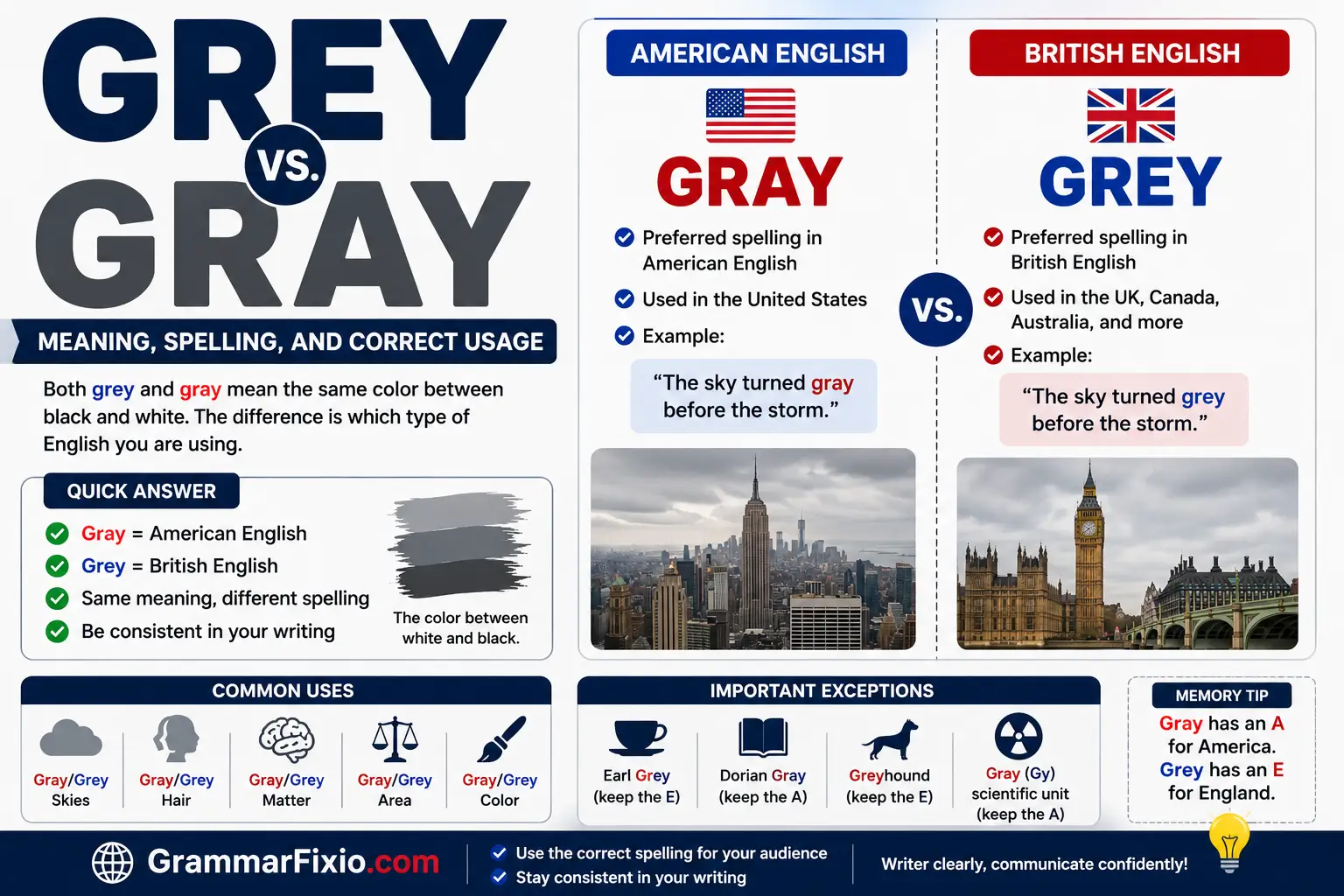
If Grey vs. Gray seems confusing, remember that both words have the same meaning, but their usage depends on the type of English you write. Grey is used predominantly in British English, while Gray is preferred in American English. Both spellings are correct in standard English, so the best choice depends on your audience, context, and personal preference.
Think of Grey and Gray as two accepted variants of the same color or colour. They describe the intermediate color between white and black and are mostly used as an adjective, although they can also be a noun or verb. This simple guide helps you learn the difference, improve your writing, and build a stronger vocabulary with correctly used words.
When you begin reading different books, you will notice one spelling changes by country, not by meaning. Read with confidence, use the form that matches your language style, and spell it exactly the same throughout your document. This comparison answers common questions, improves communication, and helps readers understand both forms in every situation.
Quick Answer: Is Gray or Grey Correct?
Both gray and grey are standard spellings.
Use this quick rule:
- Use gray for American English.
- Use grey for British English.
- Keep the original spelling in proper names, titles, brands, and technical terms.
- Use one spelling consistently throughout the same document.
Compare these sentences:
- American English: The sky turned gray before the storm.
- British English: The sky turned grey before the storm.
Both sentences mean exactly the same thing. The spelling changes because the regional style changes.
Gray has an A for America. Grey has an E for England.
That memory trick works in most everyday situations. However, it does not apply to fixed names such as Earl Grey or Dorian Gray.
What Do Gray and Grey Mean?
Gray and grey most often describe a neutral color between black and white. However, both words also have figurative meanings related to uncertainty, dullness, age, and unclear boundaries.
Read this also: Molding vs Moulding: Which Spelling Is Correct?
Gray or Grey as a Color
As a color, gray or grey can refer to many shades. Some are light and soft, while others are dark and almost black.
Examples include:
- Light gray
- Dark gray
- Silver-gray
- Blue-gray
- Charcoal gray
- Ash gray
- Slate gray
- Dove gray
In American English, you might write:
- She wore a gray sweater.
- The house has a gray roof.
- Dark gray clouds covered the city.
- His car is metallic gray.
- The cat has soft gray fur.
A British writer would usually replace gray with grey in those sentences.
Figurative Meanings
The word can also describe something that is not literally a color.
A gray area is a situation without a clear rule or answer.
- Remote work policies can create a legal gray area.
- The school’s phone policy falls into a gray area.
A gray day can describe gloomy weather or a dull mood.
- It was a cold, gray day.
- The movie presents a gray, joyless world.
The word may also suggest aging.
- Her hair began to turn gray in her forties.
- He has a few gray hairs near his temples.
In addition, gray can describe an issue that is morally complex.
- The character isn’t completely good or evil; he exists in a moral gray area.
- The decision raises several ethically gray questions.
These meanings remain the same whether you write gray or grey.
Grey vs. Gray: What Is the Main Difference?
The only general difference is regional spelling preference.
| Feature | Gray | Grey |
| Basic meaning | A color between black and white | The same color |
| Main regional use | American English | British English |
| Also common in | The United States | The UK, Canada, Australia, New Zealand, and Ireland |
| Pronunciation | /ɡreɪ/ | /ɡreɪ/ |
| Grammar roles | Noun, adjective, and verb | Noun, adjective, and verb |
| Example | a gray jacket | a grey jacket |
| Correctness | Standard | Standard |
Neither spelling represents a different shade. Grey is not darker than gray, and gray is not warmer than grey.
Color manufacturers may use names such as warm gray, cool grey, or blue-gray. However, those extra words describe the shade. The letters a and e do not create a color difference.
When to Use Gray in American English
For writing aimed at readers in the United States, gray is normally the best choice. Major American dictionaries recognize grey, but they treat gray as the more common US spelling.
Everyday American Usage
American writers usually use gray for clothing, weather, paint, hair, animals, and objects.
- I bought a gray jacket for work.
- The walls are painted pale gray.
- A gray squirrel ran across the yard.
- Her hair is turning gray.
- The morning sky looked gray and cloudy.
- He drives a dark gray truck.
You may still see grey in American writing. It is understandable and not meaningless. However, gray looks more natural and consistent to most US readers.
Academic and Professional Writing
American schools, businesses, publishers, and news organizations generally prefer gray unless their style guide says otherwise.
Examples include:
- The graph uses gray shading to represent missing data.
- Please select the gray button at the bottom of the screen.
- The researcher identified both white and gray matter.
- The proposed policy creates a regulatory gray area.
- The office ordered 20 gray chairs for the conference room.
In formal writing, consistency matters almost as much as the regional choice. Switching between gray and grey can make a paper look poorly edited.
Common American Expressions
American English usually uses gray in these expressions:
- Gray area
- Gray hair
- Gray matter
- Gray market
- Gray skies
- Gray whale
- Gray squirrel
- Gray zone
- Gray economy
- Gray water
For example:
- The contract leaves a gray area around overtime.
- Some electronics enter the country through the gray market.
- The patient’s gray matter appeared normal on the scan.
- We reuse gray water for outdoor irrigation.
The exact spacing or hyphenation of specialized compounds may depend on a publication’s style guide.
When to Use Grey in British English
Grey is the normal spelling in British English. It is also widely preferred in Canada and many other English-speaking regions.
Everyday British Usage
A British writer would usually write:
- He wore a grey suit.
- The sky remained grey all morning.
- She chose a soft grey for the bedroom walls.
- His hair has turned grey.
- A grey squirrel entered the garden.
The meaning and pronunciation are unchanged. Only the preferred spelling differs.
Usage in Canada, Australia, and Other Regions
Grey is also common in:
- Canada
- Australia
- New Zealand
- Ireland
- South Africa
- Many international publications that follow British spelling
However, regional practice is not always perfectly uniform. A Canadian business may use American spelling because most of its customers live in the United States. Likewise, an international company may choose one house style for all markets.
Therefore, the audience and style guide should guide your decision.
Common British Expressions
British English usually prefers:
- Grey area
- Grey hair
- Grey matter
- Grey market
- Grey skies
- Grey zone
- Grey whale
For example:
- The rule creates a legal grey area.
- He has thick grey hair.
- The product entered the country through the grey market.
These phrases carry the same meanings as their American forms.
How Gray and Grey Work in Sentences
Both spellings can function as an adjective, noun, or verb. Their grammar does not change across regions.
Gray or Grey as an Adjective
An adjective describes a noun. Therefore, gray can identify the color or quality of a person, place, thing, or idea.
- She owns a gray coat.
- We watched the gray clouds gather.
- His beard has several gray hairs.
- The law contains a gray provision.
- They entered a morally gray situation.
In British English, these examples would usually use grey.
Gray or Grey as a Noun
As a noun, gray names the color itself.
- Gray is a popular color for office walls.
- The artist mixed two shades of gray.
- I prefer charcoal gray to silver.
- The image fades from black to gray.
The word can also be plural when referring to several shades.
- The designer used warm grays throughout the room.
- The painting combines blues, greens, and grays.
British English usually uses grey and greys.
Gray or Grey as a Verb
As a verb, gray means to become gray or cause something to become gray. It often refers to hair, age, color, or appearance.
- His hair began to gray early.
- Stress seemed to gray his hair.
- The fabric grayed after repeated washing.
- Her hair is graying around the temples.
British spelling follows the same pattern:
- grey
- greys
- greyed
- greying
Both sets of verb forms are standard. However, American writers generally prefer grayed and graying, while British writers are more likely to use greyed and greying.
Pronunciation of Gray and Grey
Both words are pronounced /ɡreɪ/. They sound exactly alike.
They rhyme with:
- Day
- May
- Pay
- Say
- Stay
- Play
- Way
Because the pronunciation is identical, you cannot hear whether a speaker intends gray or grey. You must choose the spelling according to the audience or the official form of a name.
For example, Earl Grey and Dorian Gray contain the same sound. However, their written forms are fixed.
Why Are There Two Spellings?
Both spellings have existed for a long time. They come from the Old English word grǣg, and spelling varied before modern conventions became established. Over time, gray became more frequent in the United States, while grey remained more common in Britain and several other regions.
English contains many regional spelling differences. For example:
| American English | British English |
| color | colour |
| center | centre |
| traveled | travelled |
| defense | defence |
| gray | grey |
However, gray and grey differ from some of these examples because both spellings remain familiar in the United States. Americans regularly encounter grey in surnames, titles, brands, and entertainment.
As a result, grey may not look as unusual to an American reader as colour or centre.
Important Exceptions to the Regional Rule
The “A for America, E for England” rule is helpful, but it is not absolute. Proper names, creative titles, technical terms, and fixed words keep their established spellings.
Proper Names and Surnames
Never change the spelling of a person’s name to match your regional preference.
- Earl Grey
- Zane Grey
- Macy Gray
- Dorian Gray
For example, Earl Gray tea would be incorrect because the name is Earl Grey. Likewise, changing Macy Gray to Macy Grey would misspell her surname.
A proper name belongs to the person, character, family, or place. Regional spelling rules do not override it.
Books, Films, and Television Titles
Published titles should keep their official spelling.
Examples include:
- The Picture of Dorian Gray
- Grey’s Anatomy
- Fifty Shades of Grey
Do not change Dorian Gray to Dorian Grey for a British audience. Similarly, do not rewrite Grey’s Anatomy as Gray’s Anatomy for American readers.
These spellings come from names within the works, not from a general color-style decision. Merriam-Webster notes that cultural titles and brand names help keep grey familiar to American readers.
Brand and Organization Names
Official names should remain unchanged.
A company may choose Gray or Grey for branding reasons. Once that spelling becomes part of its official name, writers should preserve it.
For example:
- Use the spelling shown in the company’s legal name.
- Match the spelling on the organization’s official materials.
- Do not “correct” a brand to fit your preferred dialect.
Consistency rules apply to ordinary words, not to registered or official names.
The Scientific Unit Gray
In science and medicine, a gray is the SI unit used to measure absorbed ionizing radiation. Its symbol is Gy, and one gray equals one joule per kilogram. The official technical spelling is gray, even in international scientific use.
Examples:
- The patient received a dose measured in grays.
- The absorbed dose was 2 Gy.
- Radiation treatment plans may list values in gray.
In this context, do not change the unit to grey simply because you are using British spelling.
Greyhound
The dog breed greyhound keeps the e in both American and British English.
- Correct: greyhound
- Incorrect: grayhound
Interestingly, the first part of greyhound did not develop from the color word in the usual way. Therefore, the spelling does not follow the American preference for gray.
This example shows why fixed terms should be checked rather than changed automatically.
Gray or Grey in Common Phrases
Most ordinary phrases follow regional spelling.
| American English | British English | Meaning |
| gray area | grey area | An unclear situation |
| gray hair | grey hair | Hair that has lost its earlier color |
| gray matter | grey matter | Brain tissue; sometimes intelligence |
| gray market | grey market | Trade outside approved channels |
| gray skies | grey skies | Cloudy or dull weather |
| gray zone | grey zone | A situation between clear categories |
| gray whale | grey whale | A species of whale |
| gray squirrel | grey squirrel | A type of squirrel |
Consider this pair:
- US: The policy creates a gray area.
- UK: The policy creates a grey area.
Neither version is more precise. The audience determines the expected spelling.
Correct Examples in American English
The following examples suit a US audience.
School and College
- The student used gray shading on the map.
- The professor called the issue a moral gray area.
- Please wear a gray shirt for the class photograph.
- The diagram shows white matter and gray matter.
Work and Business
- We ordered gray office chairs.
- The proposal leaves a legal gray area.
- Select the gray icon to open the settings.
- The product is available in black, white, and gray.
Email and Digital Writing
- I attached the version with the gray background.
- Please change the heading from blue to gray.
- The button appears gray when the option is unavailable.
- We need a darker shade of gray for better contrast.
Social Media and Conversation
- That gray jacket looks great on you.
- The sky is completely gray today.
- I found my first gray hair.
- We adopted a small gray cat.
Correct Examples in British English
These examples suit a British audience.
- She wore a grey jumper to work.
- The kitchen walls are pale grey.
- Dark grey clouds covered the town.
- The guidance leaves a legal grey area.
- He noticed another grey hair.
- The website uses a grey background.
- The researchers examined the brain’s grey matter.
- They bought a grey sofa for the sitting room.
The wording around the color may also differ by region. For example, Americans often say sweater, while British speakers may say jumper. However, those vocabulary differences are separate from the gray vs. grey spelling issue.
Real-Life Case Study: One Product for Two Markets
Imagine a furniture company sells the same sofa in the United States and the United Kingdom.
Its American product page might say:
Add modern comfort to your living room with this soft gray sofa.
The British product page might say:
Add modern comfort to your living room with this soft grey sofa.
The product does not change. The company adjusts the spelling to match local expectations.
However, suppose the official product name is The Greyson Grey Sofa. In that case, the company should keep the official name on both websites. It may still adapt the ordinary descriptive text around it.
This approach improves consistency without altering brand identity.
Common Mistakes with Gray and Grey
Most errors happen because writers treat one spelling as universally correct or switch between the forms without a reason.
Calling One Spelling Incorrect
It is inaccurate to say that grey is wrong or gray is wrong in every situation.
- Gray is standard American spelling.
- Grey is standard British spelling.
- Both are accepted English words.
A better correction explains the regional context.
Instead of saying, “Grey is misspelled,” say, “For a US audience, gray is the preferred spelling.”
Mixing Spellings in One Document
An article may begin with gray walls and later mention a grey ceiling. Although both spellings are valid, the mixture looks inconsistent.
Incorrectly mixed:
- We painted the walls gray.
- Next, we chose a grey carpet.
- Finally, we added gray curtains.
Consistent American version:
- We painted the walls gray.
- Next, we chose a gray carpet.
- Finally, we added gray curtains.
The same principle applies to British writing with grey.
Changing Proper Names
Do not edit a person’s surname, character’s name, or official title.
- Correct: Earl Grey
- Incorrect: Earl Gray
- Correct: The Picture of Dorian Gray
- Incorrect: The Picture of Dorian Grey
Regional preference does not allow you to rewrite a proper name.
Assuming the Spellings Describe Different Colors
Gray and grey do not identify separate shades.
Incorrect assumption:
- Gray is a light shade, while grey is a dark shade.
Correct explanation:
- Both words can describe light, medium, or dark shades.
To identify a precise color, add a modifier:
- Light gray
- Dark gray
- Warm gray
- Cool gray
- Blue-gray
- Charcoal gray
Using the Wrong Form for the Audience
A British spelling is not automatically a grammar error in an American article. However, it may conflict with the publication’s style.
For example:
- A US news site may change grey to gray.
- A UK magazine may change gray to grey.
- An international company may use one spelling across all regions.
- A quoted sentence may keep the writer’s original spelling.
Audience, house style, and context all matter.
Trusting Spellcheck Without Checking the Dialect
A spellchecker may accept both forms. It may also mark one form based on the document’s language setting.
For example:
- US English settings may recommend gray.
- UK English settings may recommend grey.
- Canadian settings may prefer grey.
Therefore, check the language setting before accepting every correction.
How to Choose Between Gray and Grey
Use this simple process.
Identify Your Audience
Ask where most readers live.
- Mainly US readers: choose gray.
- Mainly UK readers: choose grey.
- Mainly Canadian readers: grey is usually the safer choice.
- International readers: follow your organization’s style.
Check the Style Guide
A school, company, publisher, or client may require a specific form.
Follow that rule even when your personal preference differs.
For example, an American writer working for a British publication should use grey if that is the publication’s style.
Look for a Proper Name
Before changing the spelling, check whether the word belongs to:
- A person
- A fictional character
- A company
- A product
- A book
- A film
- A television show
- An organization
If it does, preserve the official spelling.
Check for a Technical Term
Some scientific and specialist terms have fixed forms.
The SI unit gray, symbol Gy, must use a. Meanwhile, greyhound keeps e.
Stay Consistent
After choosing a regional spelling, use it throughout the document.
Search the final draft for both forms. Then review every exception individually before replacing anything.
Easy Memory Tricks
A for America, E for England
This is the simplest memory aid:
- Gray → America
- Grey → England
It will guide you in most ordinary sentences.
Think About the Reader
Instead of asking, “Which spelling is correct?” ask:
“Which spelling will look most natural to my audience?”
That question leads to a more useful answer.
Remember the Exceptions
Keep these examples in mind:
- Earl Grey
- Dorian Gray
- Grey’s Anatomy
- greyhound
- Scientific unit gray
These fixed forms do not change with regional spelling.
Gray and Grey in Formal and Informal Writing
Formal and Academic Writing
In essays, reports, and research papers, follow the required dialect.
An American paper might say:
- The samples appeared gray after heating.
- The question remains a legal gray area.
A British paper might use grey instead.
However, international scientific units keep their official spelling. Therefore, a British research paper would still use the unit gray and symbol Gy.
Professional and Business Writing
Businesses should choose spelling based on their market and brand style.
Use gray for:
- US product pages
- American advertising
- US employee documents
- American customer emails
Use grey for:
- UK product pages
- British advertising
- UK customer materials
- Publications using British spelling
Consistency across menus, product names, descriptions, and metadata helps the content look polished.
Texting and Social Media
In casual writing, both spellings will be understood.
- I love your gray coat.
- I love your grey coat.
Still, your usual regional spelling will sound more natural. American users generally choose gray, while British users usually choose grey.
Direct Quotations
When quoting someone directly, preserve the original wording and spelling.
Suppose a British source writes:
“The building stood beneath a grey sky.”
An American writer should generally keep grey inside the quotation. Changing it may misrepresent the original text.
Paraphrased text, however, can follow the writer’s normal regional style.
Synonyms and Related Color Words
Several words describe colors within the broad gray family.
| Color Word | Typical Meaning |
| Charcoal | Very dark gray |
| Slate | A gray shade, often with blue tones |
| Ash | A pale or dusty gray |
| Silver | A light, reflective gray |
| Pewter | A medium metallic gray |
| Smoke | A soft, hazy gray |
| Steel | A cool metallic gray |
| Dove gray | A soft, light gray |
| Gunmetal | A dark bluish or metallic gray |
| Graphite | A deep, dark gray |
These words are related, but they are not perfect synonyms in every context.
For example, a silver car suggests a lighter and more reflective finish than a charcoal car. Likewise, slate walls may have a blue undertone, while ash-gray walls may look softer and dustier.
Use the more specific word when shade matters. Otherwise, gray is the clearest general term for a US audience.
Related Forms of Gray and Grey
Both spellings produce related word forms.
| American Form | British Form | Use |
| gray | grey | Base color word |
| grays | greys | Plural noun or present-tense verb |
| grayed | greyed | Past-tense verb |
| graying | greying | Present participle |
| grayer | greyer | Comparative adjective |
| grayest | greyest | Superlative adjective |
| grayish | greyish | Somewhat gray |
| grayness | greyness | The state or quality of being gray |
Examples:
- His hair is graying.
- The sky grew grayer.
- This is the grayest winter morning so far.
- The walls have a grayish tone.
- The photograph’s grayness creates a somber mood.
British English may use greying, greyer, greyest, greyish, and greyness.
Grey vs. Gray Practice Exercise
Choose the best spelling for each situation.
- A sentence in a US school essay describes cloudy weather:
gray / grey - A British clothing website describes a wool coat:
gray / grey - A medical report names the SI unit of absorbed radiation:
gray / grey - A menu lists a type of tea named after an earl:
Earl Gray / Earl Grey - An American article discusses an unclear legal issue:
gray area / grey area - A book review mentions Oscar Wilde’s fictional character:
Dorian Gray / Dorian Grey - A US pet article names the racing dog breed:
grayhound / greyhound - A Canadian home-design article describes a wall color:
gray / grey - A quotation from a British novel contains grey:
Keep grey / Change it to gray - An American company has already used gray throughout a report:
Continue with gray / Switch randomly between both
Answer Key with Explanations
- Gray — American English generally prefers gray.
- Grey — British English normally uses grey.
- Gray — The scientific unit has the official spelling gray.
- Earl Grey — Proper names keep their established spelling.
- Gray area — This is the usual American form.
- Dorian Gray — The character’s surname is Gray.
- Greyhound — The breed name is spelled with e in American and British English.
- Grey — Canadian English generally prefers grey, although a publication’s style may differ.
- Keep grey — Direct quotations should normally preserve the source’s original spelling.
- Continue with gray — Consistency makes the document look professionally edited.
See this also: Absence vs Absense: Which Spelling Is Correct? Meaning, Usage, Examples, and Common Mistakes
Frequently Asked Questions
There is no difference in meaning. Both words describe the color between black and white. The difference is only in regional spelling.
Both are correct. Gray is the preferred spelling in American English, while Grey is preferred in British English.
English has different regional spelling conventions. Over time, American and British English adopted different spellings for some words, including gray and grey.
Use Gray if you are writing for an American audience. Use Grey if your audience follows British English. Stay consistent throughout your writing.
Yes. Grey is the standard spelling in the United Kingdom and most countries that follow British English.
Yes. Gray is the standard spelling in American English and is used in schools, businesses, and publications across the United States.
It is better not to. Choose one spelling based on your target audience and use it consistently to keep your writing professional.
No. They refer to exactly the same color between black and white. The spelling changes, but the color does not.
No. Both words are most commonly used as adjectives, but they can also be used as nouns and verbs depending on the sentence.
A simple trick is to match the country with the spelling:
Gray → American English
Grey → British English
Using this memory tip makes it easy to choose the right spelling for your audience.
Conclusion
The choice between Grey vs. Gray is not about right or wrong. Both spellings are correct and have the same meaning. The only real difference is where they are commonly used. Gray is the preferred spelling in American English, while Grey is the standard spelling in British English. To keep your writing clear and professional, choose the version that matches your audience and use it consistently throughout your document. Once you remember this simple rule, you can write with confidence in school, business, or everyday communication.








3 thoughts on “Grey vs. Gray: Meaning, Spelling, and Correct Usage”