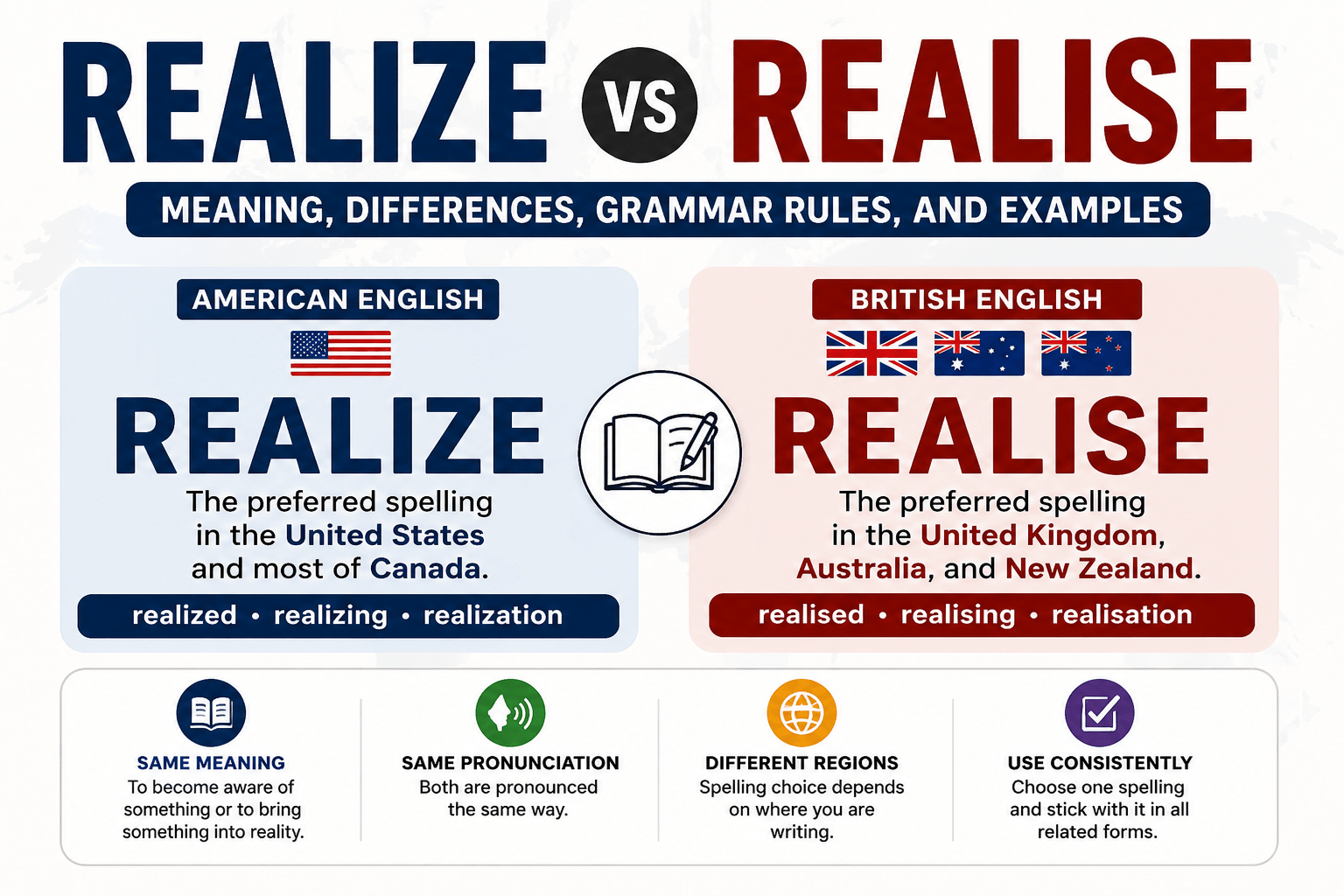
Realize vs Realise differs by one letter, but both forms have the same meaning, pronunciation, and grammar in standard written English today.
Use realize for American English and most Canadian English. Use realise for common British and Australian writing. The -ize form is not simply American. It has a long history in British English, and Oxford spelling still accepts realize. Many U.K. publishers, however, prefer realise, so check the required style guide before writing.
For clear professional writing or academic writing, choose one spelling system and keep every related form consistent. Pair realize with realized, realizing, and realization. Pair realise with realised, realising, and realisation. This simple check prevents spelling inconsistency and makes your work easier to read. It also helps your writing match its intended audience, whether you are preparing a school paper, business report, website, or formal publication, without changing the intended meaning.
Realize or Realise: The Quick Answer
Both spellings are correct.
Use realize when writing for an American or Canadian audience. Use realise for most British, Australian, and New Zealand readers.
However, always follow the requested style guide when writing for a school, employer, publisher, or client.
| Writing style or region | Preferred spelling |
| American English | Realize |
| Canadian English | Realize |
| Mainstream British English | Realise |
| Oxford spelling | Realize |
| Australian English | Realise |
| New Zealand English | Realise |
Neither spelling changes the definition or pronunciation.
Choose the spelling your audience expects, then use it consistently.
That rule will keep you out of trouble in almost every situation.
See must: Laid vs Layed: Which Spelling Is Correct in English?
What Do Realize and Realise Mean?
Realize and realise are two spellings of the same verb. The verb has several related meanings.
Most people use it when they suddenly understand or notice something. However, it can also describe achieving a goal or receiving money from an asset.
To Become Aware of Something
The most common meaning is to notice, understand, or become aware of a fact.
You may realize something suddenly:
- “I realized that I had left my phone at home.”
- “She realised the answer during the exam.”
- “They didn’t realize how late it was.”
You can also reach that understanding gradually:
- “Over time, he realised that the job wasn’t right for him.”
- “The team slowly realized how serious the problem had become.”
In both cases, the verb describes a change in understanding. You didn’t know something before. Now you do.
To Make a Dream, Plan, or Goal Real
The verb can also mean to achieve something or turn an idea into reality.
Common phrases include:
- Realize a dream
- Realise an ambition
- Realize a goal
- Realise a plan
- Realize your potential
- Realise a vision
For example:
- “She worked for a decade to realize her dream of becoming a doctor.”
- “The architects finally realised their original vision.”
- “Good training helps employees realize their full potential.”
This meaning is more formal than achieve, but it appears often in business, education, planning, and personal development.
To Gain Money or Convert an Asset into Cash
In finance, realize can mean to receive money, earn a return, or convert an asset into cash.
For example:
- “The company realized a profit from the property sale.”
- “Investors realised significant gains when the share price rose.”
- “The owner sold the artwork to realize its value.”
You may also see the terms realized profit, realized gain, and realized loss.
A gain becomes realized when an investor sells the asset. Before the sale, the gain remains unrealized because its value could still change.
Meaning Comparison Table
| Meaning | Simple explanation | Example |
| Awareness | Become conscious of a fact | “I realized my mistake.” |
| Understanding | Fully grasp an idea or situation | “She realised why he was upset.” |
| Achievement | Make a dream or goal real | “They realized their ambition.” |
| Financial return | Receive money or profit | “The investment realised a gain.” |
| Conversion | Turn an asset into cash | “The company realized the asset’s value.” |
Key Differences Between Realize and Realise
Only the spelling changes.
The words don’t have separate definitions. One isn’t more formal than the other. You also don’t choose a spelling based on whether the sentence describes awareness, achievement, or money.
Regional style determines the preferred form.
The Meaning Stays the Same
Consider these two sentences:
- “I realized that the door was unlocked.”
- “I realised that the door was unlocked.”
Both sentences communicate the same idea. The speaker became aware that the door wasn’t locked.
Now consider another pair:
- “She realized her childhood dream.”
- “She realised her childhood dream.”
Again, the meaning doesn’t change. In both cases, she achieved her dream.
The Pronunciation Stays the Same
Both words end with a z sound.
The s in realise doesn’t create an “s” sound. English spelling often allows the letter s to represent the voiced /z/ sound.
You can hear the same pattern in words such as:
- Rose
- Music
- Present
- Reason
- Easy
Both versions of the verb are usually pronounced in three syllables:
REE-uh-lize
Accents may change the exact vowel sounds. However, the spelling choice doesn’t create a pronunciation difference.
The Grammar Stays the Same
Both forms function as verbs. They take the same objects, clauses, and grammatical structures.
For example:
- “He realized the truth.”
- “He realised the truth.”
- “We realized that we needed help.”
- “We realised that we needed help.”
The regional spelling changes the letters. It doesn’t change how the sentence works.
Difference Summary Table
| Feature | Realize | Realise |
| Part of speech | Verb | Verb |
| Meaning | Become aware, achieve, or obtain | Identical |
| Pronunciation | Ends with a z sound | Ends with a z sound |
| American usage | Standard | Uncommon |
| British usage | Accepted in some styles | More common |
| Canadian usage | Generally preferred | Less common |
| Australian usage | Less common | Preferred |
| Grammar | Standard verb patterns | Identical patterns |
Realize in American English
Realize is the standard spelling in the United States.
American dictionaries, schools, businesses, newspapers, and publishers generally use the -ize form. American readers will normally expect realize, realized, and realizing.
Common American forms include:
- Realize
- Realizes
- Realized
- Realizing
- Realization
- Realizable
Examples:
- “Did you realize the office closes early on Fridays?”
- “She realized that the figures were incorrect.”
- “The company is realizing the benefits of automation.”
- “The realization came too late.”
American readers will understand realise. However, it may look like a British spelling choice or an editorial inconsistency.
Therefore, use realize when creating content for a US audience unless a specific style guide tells you otherwise.
Realise in British English
Realise is the more common form in general British writing.
You’ll often see it in British schools, newspapers, websites, novels, business documents, and everyday communication.
Examples include:
- “I didn’t realise the shop had closed.”
- “She realised that she had boarded the wrong train.”
- “The project helped him realise his potential.”
- “They are realising their original plan.”
Still, realize isn’t automatically wrong in British English.
The Oxford Spelling Exception
Some British publishers and international organizations follow Oxford spelling, which prefers -ize endings in words where that ending has an established linguistic basis.
Under Oxford spelling, a writer may use:
- Realize
- Organize
- Recognize
- Emphasize
- Realization
This system remains British English. Using realize doesn’t automatically turn the entire document into American English.
For example, an Oxford-style document could contain:
- Realize
- Colour
- Centre
- Travelling
- Defence
That combination may look unusual to readers who learned a simple American-versus-British rule. However, it follows a recognized British editorial tradition.
Why the Style Guide Matters
Suppose two British publishers hire writers for similar projects.
One publisher may require:
- Realise
- Organise
- Recognise
The other may follow Oxford spelling and require:
- Realize
- Organize
- Recognize
Both publishers use legitimate British conventions. Therefore, geography alone can’t always determine the correct form.
Check the organization’s house style before making final edits.
Regional Usage Across English-Speaking Countries
English spelling varies across countries. However, those patterns aren’t random. Dictionaries, education systems, publishers, and institutional style guides reinforce local preferences.
United States
American English strongly prefers realize.
Use the complete -ize word family:
- Realize
- Realized
- Realizing
- Realization
- Realizable
Using realise in American content usually won’t confuse readers. Still, it may appear inconsistent or incorrectly localized.
Canada
Canadian English generally prefers realize.
This choice surprises some writers because Canadian English keeps several British-style spellings, including:
- Colour
- Centre
- Defence
- Travelling
However, Canadian spelling doesn’t copy British spelling in every case. It combines conventions from different traditions.
Therefore, a Canadian document may naturally use both colour and realize.
United Kingdom
Most general British writing favors realise.
However, realize remains accepted under Oxford spelling and certain institutional style guides.
For ordinary content aimed at a broad UK audience, realise is usually the safer choice. For academic, publishing, or organizational work, check the required standard.
Australia
Australian English generally prefers realise.
Related forms include:
- Realised
- Realising
- Realisation
- Realisable
Australian readers will understand the -ize forms. Nevertheless, consistent -ise spelling usually looks more natural in locally targeted content.
New Zealand
New Zealand English also tends to favor realise.
As with Australian and British English, specific institutions may set their own editorial rules. Match the requested guide when one exists.
International English
“International English” doesn’t describe one fixed spelling system.
An international business may choose American English because it serves US customers. A global academic organization might use Oxford spelling. Another company may adopt mainstream British English.
Consequently, writers shouldn’t switch between spelling systems simply because readers live in several countries.
Choose one standard. Then apply it consistently.
Grammar Rules for Realize or Realise
The verb works with several common sentence patterns. Learning these patterns will help you use it naturally.
Verb Followed by a Noun
You can place a noun phrase directly after the verb.
Pattern: subject + realize/realise + noun
Examples:
- “She realized her mistake.”
- “They realised the danger.”
- “He realized his ambition.”
- “The company realised a profit.”
The noun tells readers what someone understood, achieved, or obtained.
Context determines the exact meaning.
For example, realized the danger means “became aware of the danger.” In contrast, realized his ambition means “achieved his ambition.”
Verb Followed by a That-Clause
The verb often introduces a complete idea with that.
Pattern: subject + realize/realise + that + clause
Examples:
- “I realized that the keys were missing.”
- “She realised that the deadline had passed.”
- “We realized that the original plan wouldn’t work.”
In informal writing, you can often remove that:
- “I realized the keys were missing.”
- “She realised the deadline had passed.”
Both versions are grammatically correct. Keep that when it improves clarity or prevents the reader from misreading the sentence.
Verb Followed by a Question Word
You can also use the verb before how, why, what, where, or when.
Examples:
- “He realized why the engine had stopped.”
- “They realised how much the repairs would cost.”
- “I realized what she was trying to explain.”
- “She realised where she had seen him before.”
This structure often introduces newly understood information.
Verb Used With Goals and Potential
When the verb means “achieve,” it often appears with nouns such as:
- Dream
- Goal
- Ambition
- Plan
- Vision
- Potential
- Objective
Examples:
- “The scholarship helped her realize her potential.”
- “He realised his goal of opening a restaurant.”
- “The team worked together to realize the director’s vision.”
Although these sentences are correct, achieve may sound more direct in everyday writing.
For example:
- Formal: “She realized her professional ambitions.”
- Simpler: “She achieved her professional goals.”
Choose the form that suits the tone.
Realized vs. Realised
The past tense follows the same regional pattern as the base verb.
Use realized in American, Canadian, or Oxford-style writing. Use realised in mainstream British, Australian, or New Zealand writing.
Examples:
- American: “He realized that he had made an error.”
- British: “He realised that he had made an error.”
- American: “The business realized a healthy profit.”
- British: “The business realised a healthy profit.”
Both forms can serve as the simple past tense or past participle.
Simple Past
- “I realized the truth yesterday.”
- “I realised the truth yesterday.”
Present Perfect
- “She has realized her mistake.”
- “She has realised her mistake.”
Past Perfect
- “They had realized the risk before the meeting.”
- “They had realised the risk before the meeting.”
Passive Voice
- “A large profit was realized from the sale.”
- “A large profit was realised from the sale.”
The passive structure appears most often in formal financial or business writing.
Realizing vs. Realising
The -ing forms also depend on regional style.
- American, Canadian, and Oxford style: realizing
- Mainstream British, Australian, and New Zealand style: realising
Both forms drop the final silent e before adding -ing.
Examples:
- “She is realizing how difficult the task will be.”
- “She is realising how difficult the task will be.”
- “The student is realizing his full potential.”
- “The student is realising his full potential.”
| Grammatical form | -ize style | -ise style |
| Base verb | Realize | Realise |
| Third-person singular | Realizes | Realises |
| Simple past | Realized | Realised |
| Past participle | Realized | Realised |
| Present participle | Realizing | Realising |
Realization vs. Realisation
The noun forms are realization and realisation.
Use realization with an -ize spelling system. Use realisation with an -ise system.
The noun can describe awareness:
- “The realization made her nervous.”
- “His realisation came several days later.”
It can also describe making something real:
- “The project marked the realization of a long-term plan.”
- “The building represented the realisation of the architect’s vision.”
Related Word Forms
| Word type | -ize style | -ise style |
| Verb | Realize | Realise |
| Past tense | Realized | Realised |
| Continuous form | Realizing | Realising |
| Noun | Realization | Realisation |
| Adjective | Realizable | Realisable |
Realizable and realisable mean capable of being achieved, obtained, or converted into money.
Examples:
- “The plan is ambitious but realizable.”
- “The asset has a realisable value of $50,000.”
The adjective appears more often in formal, legal, and financial contexts than in casual conversation.
Real-Life Examples in Different Contexts
Context shows how flexible this verb can be.
Emotional Awareness
- “She suddenly realized how much she missed her family.”
- “He realised that his words had hurt her.”
- “I didn’t realize how worried everyone had been.”
Here, the verb introduces an emotional discovery.
Everyday Mistakes
- “I realized I had worn two different socks.”
- “She realised the milk had expired.”
- “We didn’t realize the road was closed.”
These examples describe ordinary moments of awareness.
Workplace Communication
- “The manager realized that the schedule was unrealistic.”
- “The team realised they needed additional training.”
- “After reviewing the report, the director realized the figures were outdated.”
In professional writing, the verb often introduces a problem, decision, or new understanding.
Education
- “The student realized why the formula worked.”
- “Teachers realised that the class needed more practice.”
- “She began to realize her academic potential.”
The first two examples relate to understanding. The final example relates to development and achievement.
Business and Finance
- “The company realized a profit of $2 million from the sale.”
- “Investors realised a loss after selling the shares.”
- “The business hopes to realize more value from its property portfolio.”
Financial context gives the verb a more technical meaning. The gain or loss becomes real when the transaction occurs.
Creative Work
- “The director realized her vision through careful casting.”
- “The design team realised the concept in physical form.”
- “New technology helped the artist realize an ambitious installation.”
In creative settings, the verb often means turning an imagined concept into something visible or tangible.
Illustrative Case Studies
These brief scenarios show why spelling consistency matters in real writing.
Case Study: An American Business Website
A software company based in Texas publishes a homepage containing these sentences:
- “Realise your team’s potential.”
- “We help businesses realize better results.”
- “Customers are realising the benefits every day.”
Every word is understandable. However, the page mixes British and American spelling.
A consistent American version would read:
- “Realize your team’s potential.”
- “We help businesses realize better results.”
- “Customers are realizing the benefits every day.”
The revision makes the brand look more polished. It also matches the audience’s expected spelling.
Case Study: A British University Essay
A student writes:
- “The researchers realized that the sample was too small.”
- “This realisation changed the direction of the study.”
The sentence combines -ize and -ise systems.
The student has two reasonable options.
Mainstream British style:
- “The researchers realised that the sample was too small.”
- “This realisation changed the direction of the study.”
Oxford style:
- “The researchers realized that the sample was too small.”
- “This realization changed the direction of the study.”
Either approach works when the university accepts it. Mixing them without a reason creates the problem.
Case Study: A Canadian Marketing Campaign
A Canadian company uses colour in one sentence and realize in another.
That combination isn’t inconsistent. Canadian English commonly blends conventions that readers associate with Britain and the United States.
For example:
- “Choose your favourite colour.”
- “Realize your home’s full potential.”
Writers should follow Canadian conventions rather than forcing the entire document into a purely British or American system.
Common Mistakes to Avoid
The spelling issue looks small. However, several common errors can weaken otherwise strong writing.
Treating the Words as Different in Meaning
Some writers assume realize means “understand,” while realise means “achieve.”
That rule is false.
Both spellings can express every standard meaning:
- Become aware
- Understand
- Achieve
- Make real
- Receive a profit
- Convert value into cash
Region and style determine the spelling. Meaning doesn’t.
Calling Realize Incorrect in British English
Realise is more common in general British writing. Still, realize has a legitimate place in Oxford spelling.
Therefore, avoid statements such as:
- “British writers must always use realise.”
- “Realize is only American.”
- “The z form is wrong in the UK.”
A more accurate explanation is:
British English commonly uses realise, while some British publications follow Oxford spelling and use realize.
Mixing Related Forms
A document shouldn’t normally contain a random combination such as:
- Realise
- Realized
- Realising
- Realization
Choose one complete word family.
Consistent -ize style:
- Realize
- Realized
- Realizing
- Realization
Consistent -ise style:
- Realise
- Realised
- Realising
- Realisation
Exceptions may occur inside quotations, book titles, company names, or text copied from another source.
Trusting Spell-Check Without Checking the Language Setting
A spell-checker may accept both forms. It may also mark the correct regional form as an error when the document uses the wrong language setting.
For example, software set to English (United States) may flag realise. Software set to English (United Kingdom) may recommend realise even when the writer follows Oxford spelling.
Check the selected language before accepting every automated suggestion.
Assuming Canada Always Follows Britain
Canadian English uses many British-looking spellings. However, realize is generally the preferred Canadian form.
Don’t automatically change it to realise simply because the document also contains colour, centre, or defence.
Memory Tricks
A simple memory trick can prevent hesitation.
Remember the Z in the USA
The USA strongly prefers the z form:
USA → realize
The letters don’t match perfectly, but the prominent z sound makes the connection easy to remember.
Connect S With Several Commonwealth Varieties
Think of the s form as common across several varieties outside North America:
- British English
- Australian English
- New Zealand English
This trick works as a general guideline. Just remember the Oxford spelling exception.
Match the Whole Word Family
Don’t memorize only the base verb. Learn the forms as a set.
- Realize, realized, realizing, realization
- Realise, realised, realising, realisation
Once you choose the first form, the others become easier.
Synonyms for Realize and Realise
The best synonym depends on the intended meaning.
A word that works for awareness may not work for achievement or finance.
Synonyms Meaning Become Aware
Use these alternatives when someone notices or understands something:
- Notice
- Recognize
- Understand
- Discover
- Grasp
- Appreciate
- Become aware of
- Come to understand
- See
Examples:
- “I realized the document was incomplete.”
- “I noticed the document was incomplete.”
However, notice may describe simple observation, while realize often suggests fuller understanding.
Synonyms Meaning Achieve
Use these words when discussing a goal, dream, or ambition:
- Achieve
- Accomplish
- Fulfill
- Attain
- Complete
- Bring about
- Make real
- Bring to fruition
Examples:
- “She realized her dream.”
- “She achieved her dream.”
- “She brought her dream to fruition.”
Achieve sounds direct. Bring to fruition sounds more formal and emphasizes a longer process.
Synonyms in Financial Writing
Possible alternatives include:
- Earn
- Generate
- Gain
- Obtain
- Produce
- Yield
- Convert
- Liquidate
Examples:
- “The sale realized a profit.”
- “The sale generated a profit.”
- “The company liquidated the asset.”
These terms aren’t perfectly interchangeable. Liquidate specifically refers to converting assets into cash, while generate means producing income or profit.
Synonym Comparison Table
| Intended meaning | Strong alternative | Example |
| Notice a fact | Notice | “She noticed the mistake.” |
| Understand deeply | Grasp | “He grasped the consequences.” |
| Learn unexpectedly | Discover | “They discovered the truth.” |
| Achieve a dream | Fulfill | “She fulfilled her dream.” |
| Reach an objective | Attain | “The team attained its goal.” |
| Produce profit | Generate | “The investment generated income.” |
| Convert an asset | Liquidate | “The company liquidated its holdings.” |
Related Words That Follow Similar Patterns
Several English verbs show the same -ize and -ise variation.
Examples include:
| American or Oxford form | Common British form |
| Organize | Organise |
| Recognize | Recognise |
| Emphasize | Emphasise |
| Finalize | Finalise |
| Apologize | Apologise |
| Authorize | Authorise |
| Standardize | Standardise |
| Visualize | Visualise |
However, don’t assume that every word ending in -ise can switch to -ize.
Some words always keep the s because -ise isn’t acting as an interchangeable suffix.
Examples include:
- Advise
- Advertise
- Arise
- Compromise
- Despise
- Exercise
- Promise
- Surprise
Forms such as advize, exercize, and promize are incorrect in standard English.
That distinction explains why a blanket “change every -ise to -ize” rule doesn’t work.
Frequently Asked Questions
Q1.Which Is Correct, Realize or Realise?
Both spellings are correct. Realize is standard in American English, while realise is more common in British, Australian, and New Zealand English.
Q2.Is Realize Used in British English?
Yes. Although many British writers prefer realise, realize is also correct under Oxford spelling and appears in some British publications.
Q3.Is It Realized or Realised?
Use realized in American, Canadian, or Oxford-style writing. Use realised in mainstream British, Australian, or New Zealand writing.
Q4.Do Realize and Realise Have Different Meanings?
No. Both can mean to become aware of something, understand a fact, achieve a goal, or turn an idea into reality.
Q5.Should I Use Realization or Realisation?
Use realization when you write realize. Use realisation when you write realise. Keeping the same spelling style throughout your document prevents inconsistency.
Conclusion
Realize and realise are both correct spellings of the same verb. They share the same meaning, pronunciation, and grammar. The only real difference is regional preference.
Use realize in American English, most Canadian English, and Oxford spelling. Use realise in common British, Australian, and New Zealand English. Whichever form you choose, keep the spelling consistent across related words such as realized, realised, realizing, realising, realization, and realisation. Following your audience or style guide will make your writing clear, accurate, and professional.